
Blog

5 Retrieval Process Mistakes That Slow Down Insurance Agency Operations
Nov 12, 2026
A slow retrieval process costs your agency more than a few lost minutes. When a client calls about a loss, a contractor needs a certificate by noon, or a renewal is 60 days out, someone has to find the right document, the right version, and the right note. Most delays trace back to five fixable habits: using the inbox as a filing cabinet, skipping an indexing standard, writing vague notes, filing changes away from the policy, and leaving access rules unwritten. This guide explains each mistake in plain agency terms, shows the fix, and shows where insurance-trained virtual specialists can take on the filing work while licensed staff keep the advice.
Key Takeaways
- Record retrieval is your team’s ability to find the right document, version, and note quickly when a client, carrier, or auditor asks. It is a practical idea, not an industry standard.
- The five mistakes are filing in the inbox, having no indexing standard, writing vague activity notes, storing change documents apart from the policy, and leaving access and handoff rules unwritten.
- The Big “I” Virtual University says documentation is central in E&O disputes and advises agencies to keep detailed records of client emails, calls, and policy recommendations.
- The Big “I” 2026 Agency Universe Study reports 9.9 staff members per agency on average, and 45% of agencies named finding and screening candidates as a top challenge. Lean teams cannot afford slow searches.
- Outsourced specialists handle defined, non-licensed tasks such as data entry, indexing, and notes. Coverage advice and decisions stay with licensed staff.
- Agents, small and mid-sized agencies, MGAs, and startup agencies can all use the same approach: start with one workflow, set clear limits, check quality, then expand.
- Insurassist offers insurance-trained back office support across eight service areas for independent agencies in the United States and Canada, according to its services page.
Introduction
It is 8:40 on a Monday morning. A long-time insured calls. Their landlord wants a certificate by noon, and last month they added a second location. Your CSR opens the agency management system (AMS) and finds the policy, but not the endorsement. That is sitting in a producer’s inbox. The last activity note reads “called client.” Two versions of the declarations page are attached, and nobody is sure which one is current.
Nobody here was careless. The agency was short on time and hands, and the files were built one rushed task at a time. But every minute spent hunting is a minute not spent serving, and every missing note is a gap you may have to explain if a claim becomes an errors and omissions (E&O) dispute.
That picture fits agencies of every size. A solo agent feels it during renewal season. A small agency adding producers feels it when files are organized five different ways. A managing general agent (MGA) with growing commercial submissions feels it, and so does a startup agency still building its first procedures. The question is not whether someone will need a file in a hurry. It is whether anyone on your team can find it.
Why Does Record Retrieval Matter to Independent Agencies Right Now?
Published research shows agencies growing, adding tools, and still short on people. In the Big “I” 2026 Agency Universe Study, agencies averaged 9.9 staff members across all positions, up from 8.2 in 2024. One in three agencies said their employee count had increased in the past two years, although small agencies were the least likely to have added staff. Finding and screening job candidates with strong potential was the top challenge overall at 45%, followed by keeping up with AI at 43% and growing personal lines business at 41%.
The same study found that dealing with multiple carrier interfaces remained the biggest technology challenge, as in earlier years. That matters for records. Every portal is another place where a policy, endorsement, or notice can land and never reach your AMS.
Clients still want a person. In the study, 86% of agents said they prefer that customer service go through the agency by phone or other non-online methods. When that call comes in, the person answering needs the file now, not after a search through three inboxes.
The E&O side is just as direct. In a Big “I” Virtual University article, Nancy Germond writes that failure-to-procure allegations are hard to defend when staff did not put proper documentation in the insured’s file. She also repeats a rule her early managers used: “If it’s not in the file, it didn’t happen.”
None of this proves your agency has a records problem. It does explain why one can build up quietly.
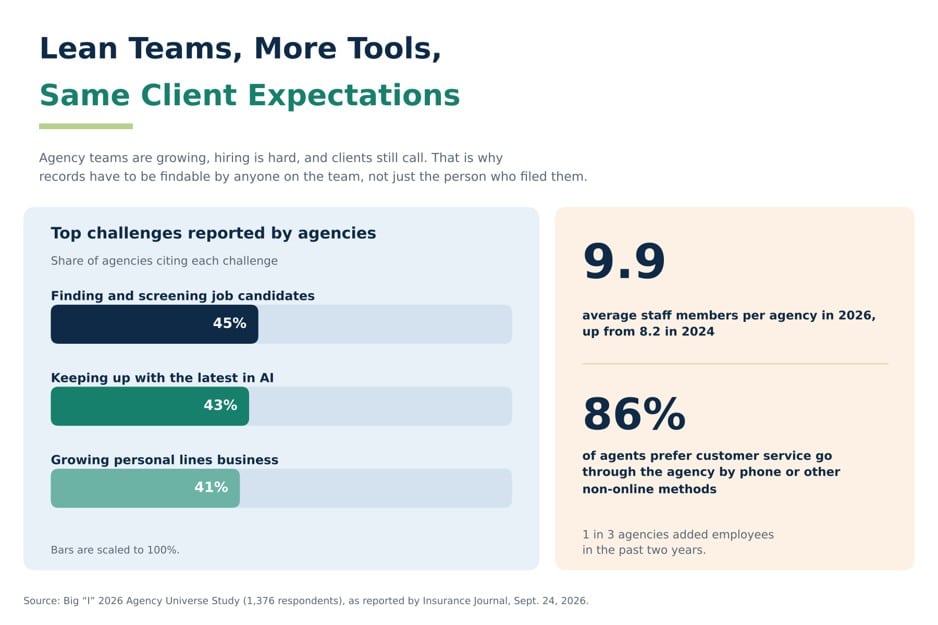
Source: Big “I” 2026 Agency Universe Study (1,376 respondents), as reported by Insurance Journal, September 24, 2026.
What Does a Healthy Agency Record System Look Like?
A healthy system is boring on purpose. Five traits show up again and again.
- One home. The AMS holds the shared record. Email and carrier portals feed it. They do not replace it.
- One index. Every document type, name, and location follows a written standard, so anyone can find it.
- Clear notes. Activity notes say who, what, and what happens next, with a date.
- Linked items. The policy, its endorsements, certificates, and renewal paperwork sit together by policy term.
- Controlled access. Everyone knows who may see and change what, and what happens when someone leaves.
Insurance back office support is how many agencies keep those traits alive. It means trained remote staff who handle defined administrative workflows, such as AMS data entry, document indexing, policy checking, certificate tracking, claim follow-up, and billing tasks. You may also see it called a virtual insurance specialist or insurance operations support. None of those titles authorizes coverage advice, and the rules on what non-licensed staff may do vary by state. Confirm them with your department of insurance or your attorney.
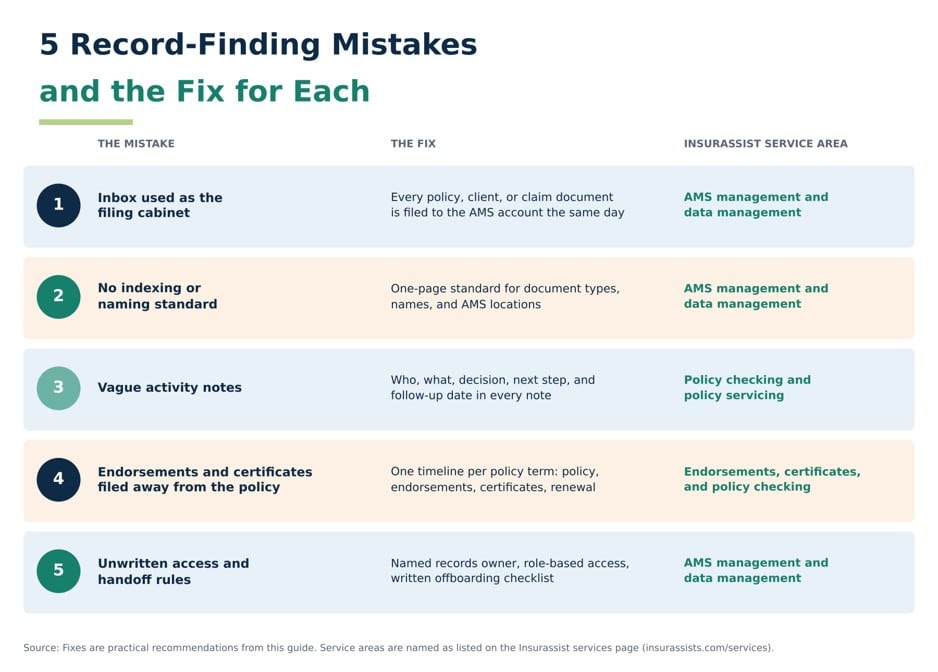
Source: Fixes are practical recommendations from this guide. Service areas are named as listed on the Insurassist services page.
Five Record-Finding Mistakes That Slow Agency Work
Each mistake below is common, easy to miss, and fixable without replacing your AMS.
1. Treating the Inbox as the Filing Cabinet
What it looks like. A producer gets a revised quote by email. A CSR saves a signed application to the desktop “to upload later.” The issued policy stays in a carrier portal. Three places hold the file, and none of them is the AMS.
Why it slows you down. An inbox belongs to one person. When that person is out sick, on vacation, or gone, the file goes with them. Your AMS exists to be the shared record, so a document that never reaches it is invisible to everyone else. Portals make this worse. With multiple carrier interfaces named again as the biggest technology challenge in the Big “I” study, documents already scatter across systems.
The fix. Set one rule: if a document affects a client, a policy, or a claim, it is filed to the AMS account the same day. Then list what counts as a record, such as signed applications, declination forms, quotes, binders, policies, endorsements, certificates, loss runs, claim reports, and key emails. Add a short end-of-day sweep of personal inboxes, shared mailboxes, and portal download folders until the habit sticks.
Where support fits. A trained specialist can run that sweep, file documents to the right account, and keep client data current. Insurassist lists AMS management and data management among its services, including accurate client data entry, policyholder record updates, and digital file organization.
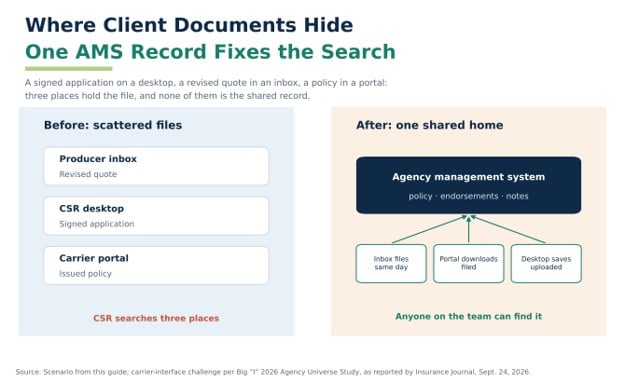
Source: Scenario from this guide; carrier-interface challenge per the Big “I” 2026 Agency Universe Study, as reported by Insurance Journal, September 24, 2026.
2. Skipping an Indexing and Naming Standard
What it looks like. One CSR saves a file as “Smith app final.” Another saves “ACORD 125 Smith 2026.” A third drops everything into a folder called “Misc.” Each label makes sense to the person who typed it.
Why it slows you down. Search only works when labels match. If each person files their own way, finding a document depends on who filed it. The Big “I” article makes a related point about procedures: when every employee follows personal habits instead of shared standards, errors can slip through the cracks.
The fix. Write a one-page filing standard and keep it where staff can see it. Cover three things: the list of document types (application, quote, binder, policy, endorsement, certificate, loss run, claim, correspondence); a naming pattern, such as insured name, policy number, document type, and effective date; and the exact AMS location for each type. A sample name might read “Smith Roofing – GL123456 – Endorsement – 2026-11-01.” That is an example format only, so use the fields your own system supports. Review the “Other” folder monthly so it does not become a dumping ground.
The same Big “I” article says a procedures manual should be kept current, updated when carriers make changes or when the agency outsources an activity, rather than sitting in someone’s inbox. Your filing standard belongs in that manual.
Where support fits. Specialists can apply your standard to incoming files and clean up older ones in batches. According to the Insurassist services page, its team has experience with Sagitta, Indio, Applied Systems, CSR24, and AMS360, so ask how your own system would be handled. Its data management service includes digital file organization and audit preparation support.
3. Writing Activity Notes Nobody Can Use Later
What it looks like. The note says “called client” or “sent docs.” There is no name, no request, no outcome, and no next step.
Why it slows you down. A thin note forces the next person to rebuild the story from emails and memory. It also weakens your position in a dispute. The Big “I” article advises recording precisely whom you spoke with, what you said, and how they responded. It also recommends sending a declination form when a client turns down a coverage you discussed, such as flood or earthquake, and says proof that you sent it can help defend a claim even if the insured never returns it.
The fix. Use a five-line note template: who you spoke with, what they asked or you offered, what was decided or declined, what you did next, and the follow-up date. Write the note the same day. Require it for renewals, endorsement requests, claim reports, and billing contacts. Spot-check a handful of notes each month and coach on gaps.
Where support fits. Notes suit trained support because the format repeats. The Insurassist services page lists documentation of all activity notes within its policy servicing work and activity note documentation within its data management service. Notes that record a coverage recommendation should still come from, or be approved by, a licensed team member.
4. Filing Changes Away From the Policy They Belong To
What it looks like. The endorsement is in an email. The certificate is in a certificate folder. The renewal notice sits in a carrier portal. A client asks, “Is the new truck covered?” and your CSR has to assemble the answer from three places.
Why it slows you down. The Big “I” article lists administrative errors, such as a wrong effective date, among the most frequent E&O claim causes. It warns agencies not to rely on the carrier to always get it right and recommends a thorough review of all new and renewal policies. It also describes gaps on umbrella and excess policies when a new vehicle, piece of equipment, or location is never added to the schedule, and it suggests diary reminders so contractors and trucking firms report changes quarterly or semi-annually. Those reminders only help if the replies land on the right policy.
Certificates add another layer. The ACORD 25 states that it is issued as a matter of information only and does not amend, extend, or alter the coverage afforded by the policies listed. It also says that if the holder is an additional insured, the policy must have additional insured provisions or be endorsed. So a certificate has to match the policy, and the policy file has to show the endorsement behind it.
The fix. Keep one timeline for each policy term: the issued policy, every endorsement, each certificate, and the renewal notice, in date order. Check each issued policy against the quote and application, and note who reviewed it and when. Log every endorsement with its request date, effective date, and carrier confirmation. Track certificate holders by policy and expiration date.
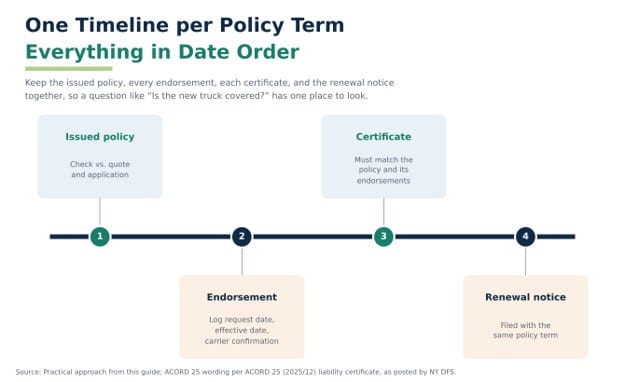
Source: Practical approach suggested in this guide; ACORD 25 wording per the ACORD 25 (2025/12) liability certificate, as posted by the New York State Department of Financial Services.
Where support fits. Insurassist lists policy checking, endorsements, and certificate of insurance management among its services, including additional insured endorsements, certificate tracking, and contract compliance checks. For more detail, read 7 ways a virtual insurance specialist can improve endorsements for insurance agencies and how a virtual insurance specialist can streamline certificate requests.
5. Leaving Access and Handoff Rules Unwritten
What it looks like. Staff share one login. Everyone can open every file. Nobody can say where a departed CSR kept her open items. When outside help joins, it gets broad access “to make things easy.”
Why it slows you down. Unclear access cuts both ways. Too little, and people wait on someone else to pull a file. Too much, and client information is exposed. The NAIC Insurance Data Security Model Law (#668), adopted in October 2017, asks licensees to develop, implement, and maintain a risk-based information security program, including a person responsible for overseeing it. It also requires licensees to investigate certain cybersecurity events and notify the state insurance commissioner, and it phases in oversight of third-party service providers.
The NAIC’s October 2026 brief says the model had been implemented in 28 jurisdictions as of October 8, 2026. The model exempts licensees with fewer than 10 employees, as well as agents and other licensed staff covered by another licensee’s program. States differ in what they adopted, so confirm what applies to your agency with your department of insurance or your attorney.
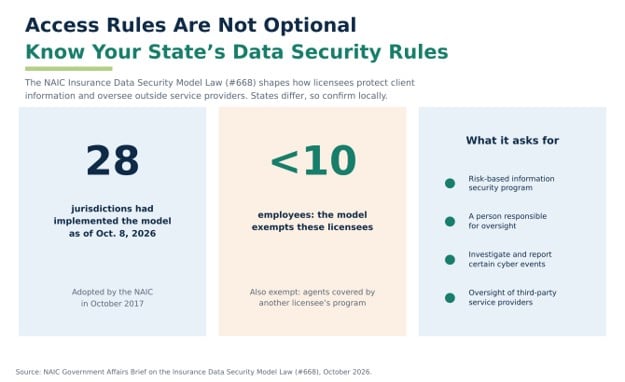
Source: NAIC Government Affairs Brief on the Insurance Data Security Model Law (#668), October 2026.
The fix. Name one person who owns records and access. Give each role the access it needs and use unique logins instead of shared ones. Write an offboarding checklist: remove access, reassign accounts and diaries, and review open items before the last day. Before any outside team touches your system, ask how access is granted, what confidentiality practices apply, and who can see what, then put the limits in writing.
Where support fits. Insurassist says it integrates its specialists into your agency management system and carrier workflows, so the work happens inside your own system. Ask any partner, Insurassist included, about access controls and confidentiality before access is granted. To start that conversation, get started with Insurassist.
What Can a Trained Specialist Handle, and What Stays With Licensed Staff?
Outside support works best when everyone knows where the line is. This table shows a common split for record-related work. Your own procedures and your state’s rules decide the final answer.
| Task | Trained specialist can handle | Keep with licensed staff |
|---|---|---|
| Filing and indexing | File documents to the AMS, apply your naming standard, clean up older files | Setting the record standard and retention decisions |
| Activity notes | Record contacts, requests, and follow-ups in the agreed format | Notes that capture coverage advice or recommendations |
| Policy checking | Compare the issued policy with the quote and application and flag differences | Deciding how to resolve a coverage issue with the carrier or client |
| Certificates | Issue from templates, track holders and expirations, check against contract terms | Unusual wording, coverage questions, and additional insured judgment calls |
| Endorsements | Log requests, submit changes, confirm with the carrier, update the AMS | Deciding what coverage a change requires |
| Claims intake | Collect first notice of loss details, report to the carrier, log each contact | Coverage interpretation and claim strategy |
Who Benefits Most From a Cleaner Records System?
Agents and solo producers. You wear every hat. A trained specialist can handle the filing so a sick day or a heavy renewal month does not stop service.
Small and mid-sized agencies. The Big “I” study found that small agencies were the least likely to have added staff. Outside support lets a lean team add capacity without waiting for the right hire.
MGAs. Submission files, binding records, and program documents grow with volume. Consistent indexing keeps intake moving while underwriting decisions stay with your team. Insurassist lists commercial lines processing support, including submission preparation, ACORD form completion, loss run gathering, carrier follow-ups, and proposal assembly.
Startup agencies. You are writing your first procedures. Building the filing standard on day one is easier than retrofitting it after hundreds of files pile up.
How Do You Fix Your Records Without Disrupting the Team?
- Run a find-it test. Pick five active accounts. Ask someone other than the account owner to find the current policy, every endorsement, the latest certificate, the renewal notice, and the last three activity notes. Write down what takes too long or cannot be found.
- Pick one workflow. Start where files slip most often, such as renewals or certificates.
- Write the standard. Cover document types, the naming pattern, AMS locations, the note template, and authority limits. Keep it short enough that people will read it.
- Apply it going forward, then clean up. File new documents by the standard now. Clean older files in batches, starting with accounts renewing soonest.
- Check quality monthly. Review a small sample, and track how long files take to find, how many items stay open, and how many corrections are needed. Expand only when the first workflow runs cleanly. For ideas, read how audits help agencies get more from virtual insurance specialists.
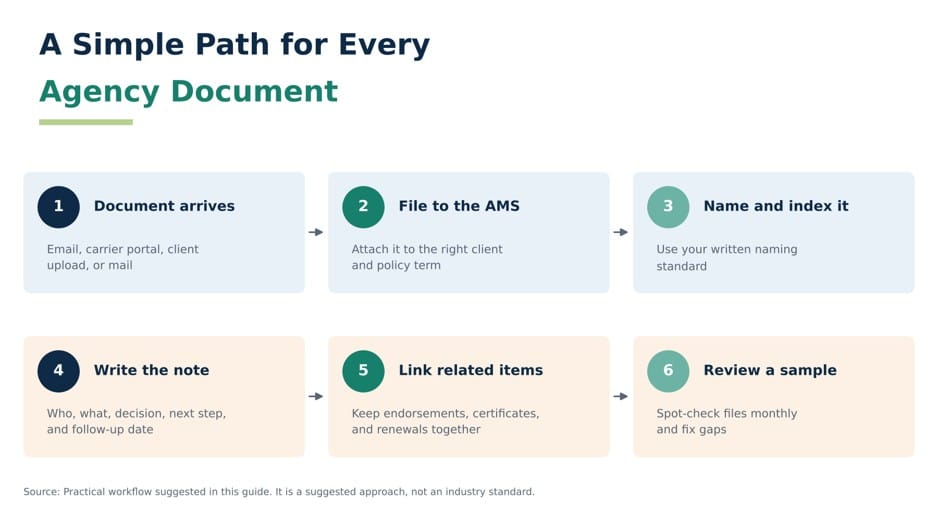
Source: Practical workflow suggested in this guide. It is a suggested approach, not an industry standard.
Record-Finding Readiness Checklist
- Every client document is filed to the AMS the same day it arrives.
- A written naming and indexing standard exists, and staff can say where it lives.
- Activity notes show who, what, the decision, the next step, and a follow-up date.
- Each policy term has its policy, endorsements, certificates, and renewal notice together.
- Someone other than the account owner can find a client’s key documents on request.
- Access is role-based, logins are unique, and an offboarding checklist exists.
If several boxes are empty, the cause may not be your people. It may be capacity, or simply the lack of a shared standard.
What Should You Ask Before You Outsource Record Work?
| Question to ask | Why it matters |
|---|---|
| Is the team insurance-trained? | Someone who knows an endorsement from a certificate, and why a loss run matters, needs less correction. |
| Do they work inside your AMS? | Records should live in your system, not in a separate spreadsheet. |
| Is the scope in writing? | You should know which tasks are covered and which decisions stay with licensed staff. |
| How is the work documented? | Activity notes and verification steps should look the same every time. |
| How is client data protected? | Ask about access controls and confidentiality before access is granted, and check your state’s data security rules. |
How Insurassist Supports Your Agency’s Record Management
Insurassist provides insurance-trained virtual assistants to independent agencies across the United States and Canada. According to its services page, the team integrates with the agency’s management system and carrier workflows. The services below map to the five mistakes in this guide.
| Record task | Insurassist service |
|---|---|
| AMS management and data management | Data entry, policyholder record updates, activity note documentation, digital file organization, audit preparation, report generation. |
| Policy checking and policy servicing | New business setup in AMS, issuance follow-up with carriers, policy checking and verification, renewal processing, cancellation processing, activity notes. |
| Endorsements and agency operations | Processing endorsements and mid-term changes so requests and confirmations are logged. |
| Certificate of insurance management | Certificates of liability insurance, evidence of property insurance, additional insured endorsements, tracking, contract compliance checks. |
| Claims intake | FNOL intake, initial carrier reporting, documentation collection, status follow-ups. |
| Client support | Insured email, renewal follow-up, policy document delivery, live chat and inbound messages. |
| Commercial lines processing | Submission preparation, ACORD forms, loss runs and underwriting documents, carrier follow-ups, proposal assembly. |
| Billing support | Invoice generation, premium reminders, payment tracking documentation, receivable aging reports. |
For related reading, see maintaining records accurately with insurance back office support, 7 ways virtual insurance specialists resolve processing exceptions faster, how to improve reconciliations with insurance-trained virtual specialists, and 5 ways back office insurance support helps manage interruption in agency operations.
Ready to make your agency’s records easy to find? If your producers and CSRs are spending too much time hunting for files, Insurassist can help with policy servicing, certificates, claims intake, client support, AMS management, and billing support. Explore the full list of insurance back office services or get started with Insurassist to talk through where your agency needs the most help.
Final Takeaway
Agencies are adding staff and tools, hiring remains a top challenge, and clients still expect a fast, accurate answer. That makes findable records a daily operating need, not a filing project. The five habits in this guide are common and fixable: file to the AMS, index consistently, write usable notes, keep changes with the policy, and write down who can access what.
This does not mean every agency needs outsourced help, and clean records will not prevent every E&O claim. Test the approach on one workflow, set clear limits, check the results, and expand when the quality holds. Strong files and clear handoffs are what let a busy agency answer the next urgent call with confidence.
FAQ
What is the best way to organize insurance agency records?
Keep one shared home in the AMS, use a written naming and indexing standard, write dated activity notes, and keep each policy term’s documents together. Start with one workflow and expand once it runs cleanly.
What should an activity note include?
Include who you spoke with, what was asked or offered, what was decided or declined, what you did next, and the follow-up date. The Big “I” article advises naming the person precisely instead of using a vague entry.
Can a virtual specialist work inside my agency management system?
Insurassist says it integrates its specialists into the agency’s management system and carrier workflows, and lists experience with Sagitta, Indio, Applied Systems, CSR24, and AMS360. (Insurassist services) Confirm that your own system is supported before you start.
Do small agencies need a written information security program?
The NAIC model law exempts licensees with fewer than 10 employees from the information security program requirement, but states differ in what they adopted. Check with your department of insurance or your attorney.
Can a virtual specialist give coverage advice?
No, not for anything that requires a license. Rules on what non-licensed staff may do vary by state, so confirm them with your department of insurance or your attorney and write the limits into your procedures.
Research and Further Reading
- Andrea Wells, “Independent Agencies Total About 37,000 in 2026, a Decrease From 2024,” Insurance Journal (September 24, 2026), reporting the Big “I” 2026 Agency Universe Study.
- Nancy Germond, “Five Top Tips to Prevent the Most Frequent Errors & Omissions Claims Against Insurance Agencies,” Big “I” Virtual University (June 13, 2025).
- “ACORD 25 Certificate of Liability Insurance, edition 2025/12,” PDF hosted by the New York Department of Financial Services.
- NAIC, “NAIC Insurance Data Security Model Law,” government affairs brief (October 2026; implementation status as of October 8, 2026).
- Insurassist, “Our Services,” accessed November 3, 2026.
Latest Posts

What an Insurance Virtual Assistant Actually Does (And Why It Matters)
Discover how insurance virtual assistants handle admin, quoting, client support, and operations to keep your agency efficient and compliant.
- « Previous
- 1
- …
- 8
- 9
- 10