
Blog

5 Things to Know Before Pursuing Carrier Appointments
Nov 19, 2026
Before you pursue a new carrier appointment, check five things: whether you meet the eligibility rules, whether the carrier’s appetite fills a real gap in your book, what the agency agreement says about expirations and termination, how commissions and premium will flow, and whether your team can service the new business accurately. Treat carrier appointments as a growth decision for your agency, not just a form to file.
The market backdrop makes this decision more nuanced than it may seem. Marsh reported that global commercial insurance rates fell 5% in the third quarter of 2026, while U.S. casualty rates rose 6%. These figures show how pricing and market conditions can vary significantly by line. [1,2]

Key Takeaways
- Eligibility comes first. Minnesota, for example, bars an insurer from appointing an unlicensed producer, and under the NAIC model the insurer files the appointment within 15 days of the signed agency contract or the first application, whichever comes first. [3,4]
- Appetite beats brand name. Add a carrier because it fills a gap, such as a class, state, or limit you now decline or place elsewhere.
- The contract outranks the sales pitch. Ownership of expirations, commission-change notice, indemnification, and post-termination rights all live in the agency agreement. [5]
- Know how the money moves. Agency bill versus direct bill, premium remittance language, and contingent commission conditions change both cash flow and risk. [5,6]
- Service capacity is part of the economics. A new carrier brings new portals, forms, and endorsement and certificate workflows your team must handle.
- Relationship quality matters. J.D. Power found that only 48% of independent agent-carrier relationships qualify as partnerships. [7]
- Review every carrier relationship at least once a year, and again when a contract, commission schedule, or underwriting appetite changes.
Introduction
Adding a carrier looks simple from the producer’s chair: a new market, another quote option, a new commission line. From the back office it looks different. Someone has to confirm licensing, review and sign an agreement, load the carrier into the agency management system (AMS), learn another portal, set up billing, and train the team on new forms and underwriting rules. If the carrier turns out to be a poor fit, unwinding the relationship can be harder than starting it.
This guide is written for independent agents, small and mid-sized agencies, startup agencies, and MGAs deciding whether a new carrier belongs in the lineup. It draws on state appointment rules, Big “I” guidance on agency-company contracts, the Big “I” 2026 Market Share Report, the J.D. Power 2026 U.S. Independent Agent Satisfaction Study, and Marsh’s Q3 2026 market index. Rules differ by state and by carrier, so confirm specifics with your state department of insurance, the carrier, and your own counsel. This article is general information, not legal advice.
What the Published Research Suggests
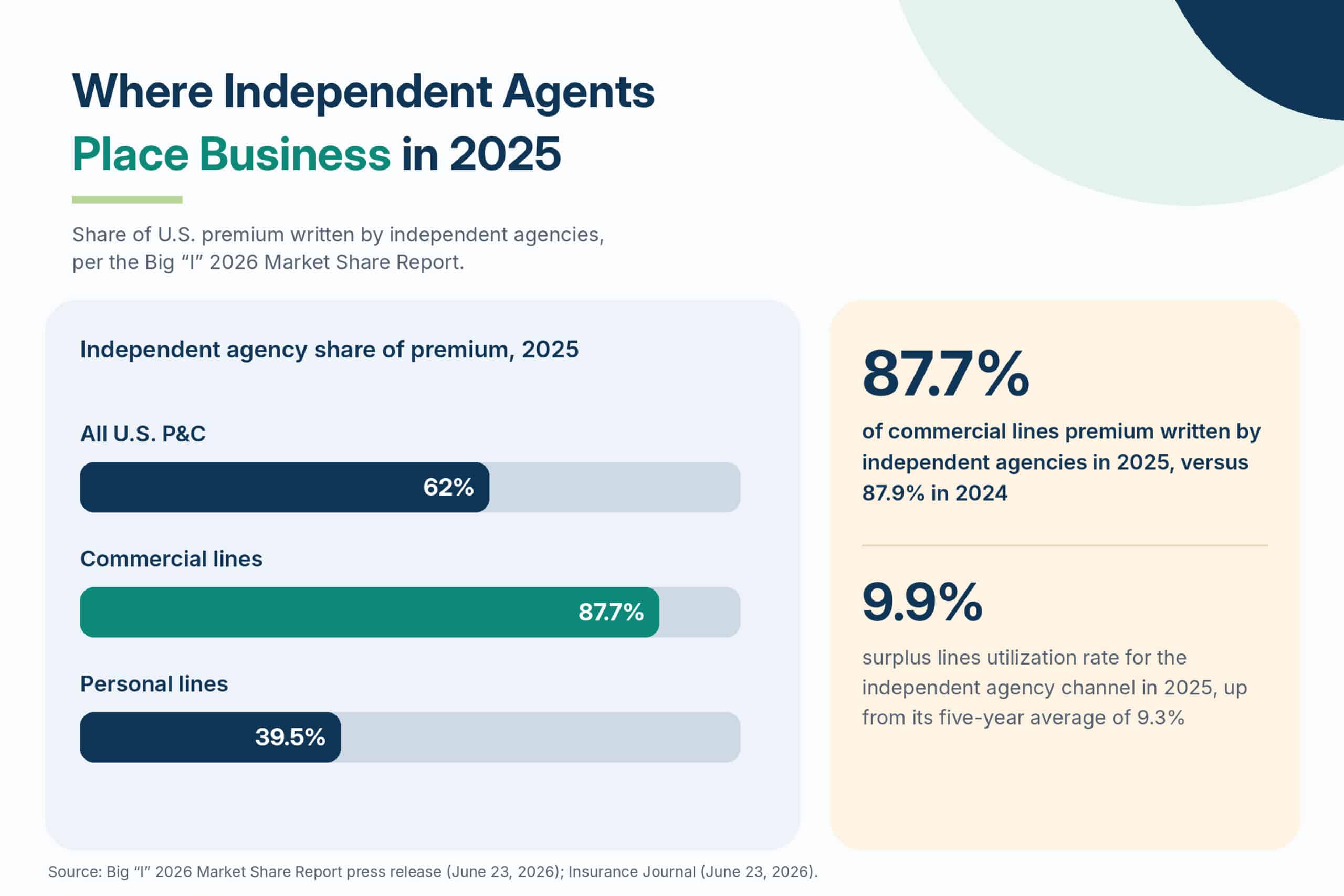
- Channel strength: Independent agencies placed 62% of all U.S. property and casualty premium in 2025 and wrote 87.7% of commercial lines premium, according to the Big “I” 2026 Market Share Report. [8,9]
- Relationship gap: J.D. Power’s 2026 study found that 48% of agent-carrier relationships qualified as partnerships, while 29% were viewed as providers and 18% as vendors. [7]
- Pricing divergence: Marsh reported global commercial rates down 5% in Q3 2026, the ninth consecutive quarterly decline, while U.S. casualty rates rose 6%. [1,2]
- Contract risk: Big “I” counsel note that the agency-carrier contract will likely override other understandings between the parties, so agencies should review and negotiate before signing. [5]
How Appointments Work: Licensing, Contracting, and the 15-Day Clock
Start with vocabulary, because agencies use two terms loosely. Contracting is the business agreement between your agency and the carrier. An appointment is the state record showing the insurer has authorized you to act as its agent. They usually travel together, but they are not the same step.
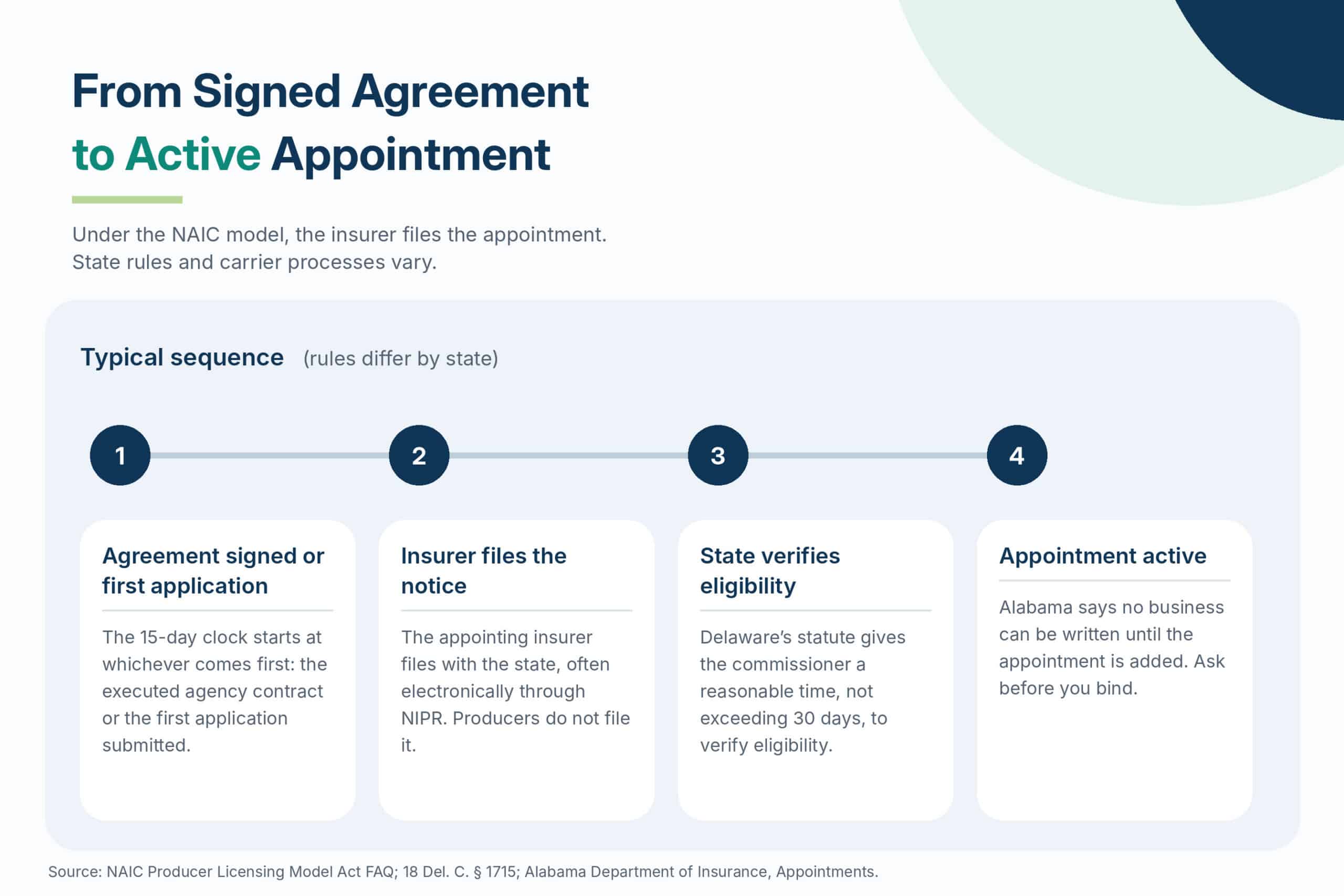
Under the NAIC Producer Licensing Model Act, the appointing insurer files the notice within 15 days from the date the agency contract is executed or the first insurance application is submitted. [3] The model act labels its appointment section optional, and states add their own variations. Alabama requires the insurer to file every appointment online through the National Insurance Producer Registry (NIPR). [10] Michigan also requires the insurer to file electronically through NIPR or an authorized business partner. [11]
Four details trip up newer agencies and startups:
- License first. Minnesota’s statute, for example, says an insurer may not appoint a producer until the producer obtains a license. [4]
- Appointment follows agent status. Delaware’s statute says a producer who is not acting as an agent of an insurer is not required to be appointed. [12] A retail agency placing business through an MGA or wholesaler may therefore handle paperwork differently from one with a direct carrier contract. Confirm which path applies in each state.
- Just-in-time filing. Because the 15-day clock can start with your first application, some carriers wait until you submit business before filing the appointment, an approach known as just-in-time appointing. [3,13] Ask when the filing will happen, confirm the carrier has authorized you to submit business, and follow the applicable state’s requirements before binding coverage. Requirements vary by state.
- In Delaware and Minnesota, the statute makes the insurer responsible for the appointment fee. [4,12] Fee amounts vary by state, so ask what the carrier passes on, if anything.
Appointments end, too. South Dakota’s Division of Insurance notes that ending a producer’s final appointment does not end the license, and insurers must notify the producer within 15 days of sending the termination notice to the state. [14]
1. Confirm You Qualify Before You Apply
Eligibility has two layers: state law and the carrier’s own standards.
State licensing. Confirm that every producer who will write for the carrier holds an active license in the right state and for the right lines. Because the carrier files the appointment, an unlicensed or lapsed producer can stall the whole process. Check expiration dates and continuing education status before you submit anything.
Carrier standards. Carriers set their own requirements on top of state law. Ask for them in writing:
- The errors and omissions (E&O) limit the carrier requires. A Big “I” review of one specialty carrier’s agency agreement flagged a $3 million E&O requirement as higher than usual, noting typical requirements are $1 million to $2 million at most. [15]
- Any production, premium, or loss ratio expectations, and what happens if you miss them.
- The classes, states, and limits the carrier will open to you, and whether you will have binding authority.
- Required documents and how long onboarding usually takes.
Preparation. Startups and newer agencies should gather license numbers, the E&O certificate, ownership details, and a clear description of the book they plan to place before applying. MGAs should also confirm that binding authority, E&O limits, and expirations language in their own sub-producer agreements are consistent with what they sign with the carrier.
2. Test Appetite and Market Fit Against Your Book
The best reason to add a carrier is a documented gap. Pull 12 months of declinations, lost quotes, non-renewals, and accounts placed in higher-cost markets, then ask whether this carrier would have changed those outcomes.
The market context helps you decide where to look. Independent agents wrote 87.7% of commercial lines premium and 39.5% of personal lines premium in 2025. [8,9] Big “I” also reported that the channel’s surplus lines utilization rate was 9.9%, up from its five-year average of 9.3%. [8] Agencies have many places to send a risk, so a new carrier needs a clear job.
Pricing makes that job different by line. Marsh reported U.S. property rates down 10% in Q3 2026, with buyers securing higher limits, caps on catastrophe deductibles, and more favorable terms. U.S. casualty rates rose 6%, led by auto and umbrella/excess, and U.S. cyber rates were flat. [1,2] These are index figures, not quotes for any single account, and your results will vary. Still, the pattern suggests a new carrier may add the most value where your current markets are tight, such as casualty, rather than where property capacity is plentiful.
Appetite is only half of fit. Relationship quality shapes how much business you can actually write. J.D. Power’s 2026 study, based on 4,355 evaluations of personal and commercial lines insurers fielded from May through July 2026, found that agents who see a carrier as a partner are 37 percentage points more likely to write more business with it. [7,16] The attributes most associated with carriers that agents view as partners were trustworthiness (76%) and innovation (50%). [16] The same study reported that commercial lines satisfaction fell 16 points to 669 on a 1,000-point scale, with declines across all six dimensions: business support, compensation, ease of doing business, operational support, product competitiveness, and client servicing. [16]

Before you commit, test the carrier directly:
- Ask for a current appetite guide and quote turnaround times.
- Submit two or three real, representative accounts and compare response speed and clarity.
- Speak with agencies that already write with the carrier about claims handling and service.
- Check whether the carrier overlaps with a market you already use. Every extra carrier adds a portal, a contract, and a commission schedule to maintain.
3. Read the Agency Agreement Line by Line
The agency agreement is the foundation of the relationship. Big “I” counsel advise that it will likely trump other understandings, that carriers’ willingness to negotiate varies, and that agencies may still win meaningful improvements before signing. [5] Their guidance highlights these provisions:
- Ownership of expirations. Big “I” calls this one of the most critical issues, since an agency derives much of its value from its expirations and records. Courts have generally recognized independent agents’ ownership of expirations since a 1904 New York decision. Even so, contracts can address when a carrier may take control of expirations after termination. Agencies should seek express carrier recognition of ownership of both expirations and records, and watch for liens or security interests in the book of business. [5]
- Look at when commissions are paid, whether the carrier may deduct them, and how much notice it must give before changing rates. Carriers typically offer 30 to 90 days of written notice before unilateral reductions, and Big “I” suggests asking for 90 or more days and limiting reductions to once a year. Be cautious of rates set policy by policy rather than in a schedule. [5]
- Premium collection. Understand agency bill versus direct bill and when the carrier can switch methods. Watch for language requiring you to pay premium “whether or not collected,” which departs from the usual result that nonpayment by an insured leads to lapse or cancellation. [5]
- Seek mutual obligations, apportioned by comparative fault rather than a contributory standard, and confirm your insurance responds to what you agree to. [5]
- Change in ownership. Notice requirements can conflict with confidentiality in a sale. The agreement should not end immediately upon a change in ownership. This matters if you plan to sell, merge, or bring in investors. [5]
- Carrier contact with your clients. Look for language that lets the carrier communicate or sell directly to your insureds, and ask for notice, commission on direct sales, and protection of your expirations. [5]
- Claims reporting. Some carriers want notice only of lawsuits, while others want notice of any circumstance that could become a claim. Broader language can mean reporting every client complaint. [5]
- Post-termination rights. Check commissions on policies that continue, access to client records, authority to service, and renewal rights. A run-off provision, such as one year of renewals for policies meeting underwriting standards, adds certainty. [5]
- Data security. New York has enacted a far-reaching data security law and the NAIC has issued a model law, so carriers are updating contracts. Push back on non-mutual or stricter-than-law requirements. [5]
MGAs and wholesalers have their own checklist. Make sure the agreement spells out the MGA’s authority to bind, how commissions are paid, and who owns the expirations, including whether that ownership depends on paying premium on time. Watch for any personal guarantee of premium payment. Big “I” Virtual University faculty also advise confirming that the MGA or wholesaler actually has binding authority with the carrier [17], and warn that hold-harmless clauses in some E&S brokerage agreements can make the retail agent liable even for the broker’s own errors, liability your E&O policy may not cover. [18]
4. Model Commissions, Billing, and Premium Flow
A new carrier should earn its place on a spreadsheet before it earns a place in your AMS. Build a simple model with four inputs: expected premium, commission rate, contingent or bonus potential, and the added service hours the account will require.
Commission schedule. Make sure the agreement has a separate schedule by line of business, and note how and when it can change. [5]
Billing method. Agency billing puts you in the premium flow and raises reconciliation work. If the agency turns uncollectable agency-billed premiums over to the carrier for collection, review whether the agreement requires commissions on those premiums to be waived. Know who can switch methods and under what conditions. [5]
Contingent commissions. Read the eligibility terms closely. In one carrier producer agreement reviewed by Big “I,” no contingent commission was payable if the producer was in breach at any time during the eligibility period, even an immaterial or timely cured breach, and the review flagged the carrier’s right to end the arrangement on 30 days’ notice or, under the separate contingent commission agreement, at any time without reason. [6] Treat contingent income as upside, not as a base for your budget.
Cash discipline. Decide who reconciles commission statements each month, who follows up on unpaid premium, and who documents the activity in the AMS. A carrier that looks profitable on paper can lose margin quickly if the back-office work is not covered.
5. Check Your Operational Capacity Before You Say Yes
Every carrier adds recurring work. Before you sign, map the workflows the new carrier will touch:
- New business setup: carrier code, commission schedule, billing method, and producer assignments in the AMS.
- Policy checking: comparing issued policies with the quote and binder to catch errors before the client does.
- Certificates and endorsements: carrier-specific turnaround times, forms, and approval steps.
- Billing follow-up: tracking payments and chasing unpaid premium on agency-billed accounts.
- Claims intake: the carrier’s first-notice-of-loss process and its claims reporting expectations. [5]
- Client communication: who answers coverage questions and sends policy documents.
If your team is already stretched, adding a carrier can lower service quality across the whole book. That is where outside support can help. InsurAssist provides insurance-trained virtual assistants who support independent agencies in the United States and Canada, working inside your AMS and carrier workflows. For a new carrier, that can include AMS management to set up new business and keep records clean, policy checking on newly issued policies, certificates and additional insured documentation, endorsements and mid-term changes, billing support such as premium follow-up and payment tracking, and claims intake with first notice of loss. Client support and commercial lines processing, including submission preparation and ACORD forms, round out the list. The InsurAssist team lists experience with many agency management systems, including Applied Systems, AMS360, Sagitta, and CSR24. Appointment filings and contract decisions stay with your agency and the carrier.
Practical Checklist Before You Sign
- List the specific gap this carrier fills, with 12 months of declinations or lost quotes as evidence.
- Confirm every producer’s license status and lines of authority.
- Ask the carrier for its E&O, production, and eligibility requirements in writing.
- Ask when the state appointment filing will happen. Confirm state appointment requirements and carrier authorization before binding.
- Review expirations, commission-change notice, premium collection, and indemnification clauses.
- Check post-termination run-off, claims reporting, and data security terms.
- Confirm the billing method and who can change it.
- Read the contingent commission conditions and termination rights.
- Build a revenue-per-service-hour estimate for the new carrier.
- Assign someone to load the carrier into the AMS and own onboarding.
- Plan how certificates, endorsements, billing follow-up, and claims intake will be covered.
- Schedule a 6-month and 12-month review of premium, service issues, and commissions.
Turning a New Carrier Into Real Growth
A carrier is only worth adding if it improves your book and your team can serve it well. Strong carrier appointments start with eligibility and fit, move through a careful contract review, and finish with a service plan that protects your clients and your E&O exposure.
If you want help carrying the added workload, InsurAssist can support your agency operations so producers and CSRs can stay focused on selling and servicing. Visit InsurAssist’s Get Started page to talk through your agency’s needs, or learn how the work is organized on the Our Process page.
Frequently Asked Questions
How Long Does the Appointment Process Take?
The NAIC model gives the insurer 15 days from the signed agency contract or first application to file. [3] Delaware’s statute also gives the commissioner a reasonable time, not exceeding 30 days, to verify that the producer is eligible. [12] The carrier’s own contracting process is separate, so ask for its timeline.
Who Files the Appointment, the Agency or the Carrier?
The insurer files it. Alabama and Michigan both require insurers to file through NIPR. [10,11]
Can I Write Business Before the Appointment Is Active?
It depends on the state and the carrier. Alabama, for example, gives the insurer 15 days from the signed agency contract or the first application, whichever comes first, to file the appointment. [10] Other states vary, so check with the carrier and your state department of insurance before you bind.
Do I Need an Appointment to Place Business Through an MGA?
It depends. The statutory requirement attaches to acting as an agent of an insurer, and Delaware’s statute says a producer who is not acting as an agent of an insurer is not required to be appointed. [12] Confirm the requirement with the MGA and your state.
Who Owns the Expirations?
Courts have generally recognized independent agents’ ownership of expirations, but the contract can limit or condition that right. Review the clause before signing. [5]
How Many Carriers Should an Agency Have?
There is no single right number. The better test is whether each carrier fills a documented gap, pays fairly, and can be serviced well by your team.
Research and Further Reading
[2] Business Insurance — Commercial insurance rates fall again in third quarter: Marsh (October 2026).
[3] NAIC — Producer Licensing Model Act (Model #218), Section 14: Appointments.
[4] Minnesota Statutes 2026, section 60K.49 — Appointments (Office of the Revisor of Statutes).
[5] IA Magazine (Big “I”) — 9 Considerations for Agency-Company Appointment Contracts (March 1, 2023).
[6] Big “I” — Berkley One Producer Agreement Review (October 2020).
[8] Independent Insurance Agents & Brokers of America — Big “I” Releases 2026 Market Share Report.
[9] Insurance Journal — Big I: Independent Agencies’ Market Share Up Slightly in 2025 (June 23, 2026).
[10] Alabama Administrative Code r. 482-1-147-.10 — Appointments (via Justia).
[11] Michigan Department of Insurance and Financial Services — Appointments and Cancellations.
[12] Delaware Code, Title 18, § 1715 — Appointments (via Justia).
[13] AgentSync — Taking Advantage of Just-In-Time Carrier Appointments (updated July 18, 2023).
[14] South Dakota Division of Insurance — Appointments and Terminations.
[15] Big “I” — Berkley Management Protection Agency Agreement Review (January 2022).
[17] Big “I” Virtual University — E&O Issues Dealing with Small Wholesalers (May 8, 2012).
[18] Big “I” Virtual University — Hold Harmless Agreements Aren’t Harmless (last updated March 10, 2023).
Latest Posts

How to Improve Reconciliations With Insurance-Trained Virtual Specialists
Learn how insurance agencies can improve financial accuracy, reduce manual workload, and give their teams more capacity to focus on clients and revenue-generating work.

How a Virtual Insurance Specialist Can Streamline Certificate Requests
Discover how specialized insurance support can simplify certificate requests and reduce administrative workload.

7 Ways a Virtual Insurance Specialist Can Improve Endorsements for Insurance Agencies
Explore how specialized support can reduce repetitive service work, improve workflow efficiency, and keep client requests moving.

5 Ways Virtual Insurance Specialists Reduce Redundancy Work
See how virtual insurance specialists can take on repetitive work and give your team more time for client-focused work.

7 Ways to Unlock Greater Savings With Back Office Support
See how insurance agencies can reduce operating costs with specialized back-office support.

5 Ways Agencies Can Improve Morale Through Elite Back-Office Support
Discover how better back-office support can reduce team workload, improve employee morale, and create a stronger agency workplace.

How Agencies Can Improve Turnaround With Insurance Operations Support
Learn how insurance operations support can help agencies reduce delays, improve workflow efficiency, and keep client requests moving.

How Insurance-Trained Support Improves Executive Oversight
Learn how insurance-trained support helps agency leaders maintain visibility without getting pulled into every operational task.

How Virtual Insurance Specialists Help Agencies Reduce Cancellations
See how dedicated back-office support can help agencies stay ahead of policy issues and protect valuable client relationships.

7 Ways to Reduce High Attrition With Back-Office Insurance Support
Explore seven ways the right back-office support can reduce team strain, improve workload management, and help insurance agencies build a more sustainable operation.

7 Ways Agencies Can Reduce Rework With Insurance-Trained Specialists
Learn seven practical strategies for reducing repeated work, correcting avoidable errors, and improving agency efficiency with specialized operational support.

5 Ways Elite Back-Office Support Improves Loss Run Work
See how back-office support can help your agency handle loss run tasks more efficiently and keep accounts moving.

7 Signs of Decision Fatigue and How Virtual Insurance Specialists Help
Learn the warning signs that your agency may be reaching its service capacity and what it means for client experience.

5 Talent Challenges Solved by Virtual Insurance Specialists
Learn how insurance agencies can overcome staffing obstacles, improve operational efficiency, and support sustainable growth with specialized back office support.

Managing High Volume Renewals With Expert Back Office Support
Discover practical strategies to streamline renewal workflows, reduce administrative strain, and maintain exceptional client service during your busiest periods.