
Blog

7 Ways Virtual Insurance Specialists Resolve Processing Exceptions Faster
Oct 27, 2026
How Can Virtual Insurance Specialists Resolve Processing Exceptions Faster?
Virtual insurance specialists resolve processing exceptions faster by finding stuck items the same day, giving each one an owner and a due date, completing the preparation and follow-up work around it, and documenting every step in the agency management system (AMS). They clear the process-driven work so licensed staff can focus on coverage decisions and client advice. Seven repeatable areas, from policy checking to claims intake, are where that support makes the biggest difference.
Every agency knows the feeling. The new business setup looked clean on Monday. By Thursday, a carrier download can’t be matched to a client or policy in your AMS, an endorsement is waiting on one missing detail, and a premium payment can’t be matched to an invoice. None of it is dramatic. Each item still pulls a licensed person away from the work that grows the book.
Those are processing exceptions: transactions that fall outside the normal flow and need a person to look at them, decide where they belong, and push them to done. In an agency, they show up in policy servicing, certificates, billing, claims intake, and the AMS itself. When nobody owns them, they age. When they age, they can lead to client complaints, missed deadlines, delayed cancellation follow-ups, coverage gaps, and potential errors and omissions (E&O) exposure.
This guide is written for agents, small and mid-sized agencies, MGAs, and startup agencies. It shows seven ways trained virtual insurance specialists can resolve exceptions faster, covers which tasks to reserve for licensed staff, and shows how to measure progress. You will find published industry data, tables, a practical framework, a checklist, and answers to common questions, all written from the agency side of the desk.
Key Takeaways
- A processing exception is any transaction that cannot move forward on its own. Left without an owner, it ages and can become a client complaint or an E&O problem.
- The fix follows one pattern: find it, assign an owner, resolve it, and document it.
- Trained virtual insurance specialists can handle the preparation, follow-up, and documentation work in seven areas, from policy checking to claims intake.
- Coverage recommendations, coverage interpretations, and any activity that requires a license stay with appropriately licensed staff.
- Use the Spot, Sort, Send, Solve, Stamp framework to sort every item by who should handle it.
- Set a baseline, then measure open items, turnaround, corrections, aging receivables, and documentation at 30, 60, and 90 days.
What Does a Processing Exception Look Like Inside an Agency?
In plain agency language, a processing exception is any transaction that cannot move forward on its own. Common examples:
- A carrier download that your AMS cannot match to an existing client or policy
- An endorsement request waiting on missing information, such as a vehicle identification number, a mortgagee, or a revised schedule
- A certificate request that asks for wording, an additional insured, or a limit the policy does not show
- A cancellation or non-renewal notice that needs client outreach before a deadline
- An issued policy that comes back with a different coverage, limit, or named insured than the client requested
Some are simple clerical gaps. Others are warning signs that something went wrong earlier. Either way, the fix follows one pattern: find it, assign an owner, resolve it, and document it. That pattern is the heart of insurance agency process optimization.
Why Do Processing Exceptions Cost More Than They Look?
Independent agencies are busy, and many operate with lean teams. The Big “I” 2026 Agency Universe Study, conducted by Zeldis Research in cooperation with Future One and based on 1,376 respondents, estimates that approximately 37,000 independent P&C agencies operate in the United States, down from 39,000 in 2024. According to Insurance Journal’s report on the study, the top challenges agencies named were finding and screening job candidates with strong potential (45%), keeping up with the latest in AI (43%), and growing personal lines business (41%). [1]
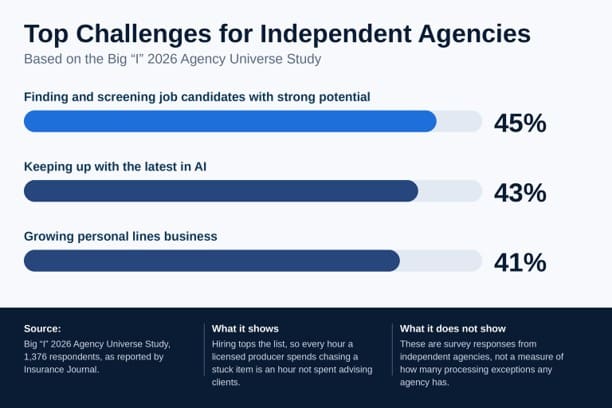
Hiring tops the list, so every hour a licensed producer spends chasing a stuck item is an hour not spent advising clients or placing business. The same study found that average agency staff size increased from 8.2 in 2024 to 9.9 in 2026, although staffing changes varied among individual agencies. [2] The study also found that 86% of agents prefer customer service to go through their agency by phone or other non-online methods, rather than primarily through carrier self-service channels. [1]
Charles Symington, Big “I” president and CEO, said, “Independent agencies are successfully navigating a changing insurance landscape and the surge of AI.” Navigating well starts with seeing how work moves through your own shop. That is insurance agency operational efficiency.
How Do Processing Exceptions Become an E&O Problem?
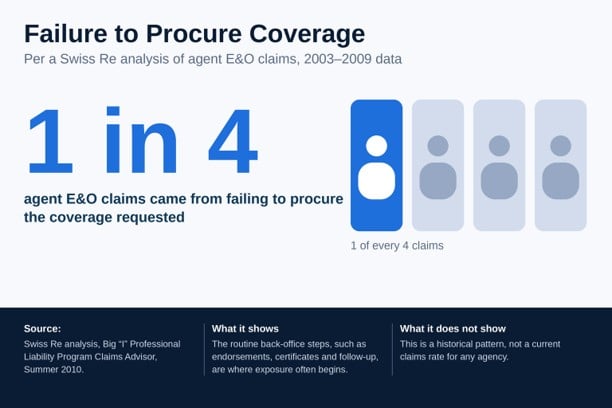
Processing exceptions are not just a productivity problem. They can also become an E&O problem. A Swiss Re analysis in the Big “I” Professional Liability Program’s Claims Advisor newsletter in 2010 reported that one in four agent E&O claims in its 2003 through 2009 data came from failing to procure the coverage requested. [3] That is a historical pattern, not a current claims rate, but the underlying lesson holds.
A 2009 Insurance Journal article on agent E&O procedures lists typical claim allegations that read like a back office to-do list: failing to add additional insureds and loss payees, failing to give the carrier timely notice of a claim, and failing to notify customers about cancellations. [4] The daily small stuff is where agency exposure often begins, which is why insurance operations management deserves as much attention as sales.
How Do Virtual Insurance Specialists Resolve Processing Exceptions Faster?
The seven areas below follow the services we offer at InsurAssist. None of them replace licensed judgment. They clear the preparation, follow-up, and documentation work around it.
1. Triage and Log Every Stuck Item the Same Day
The first job of a trained insurance agency virtual assistant is to find stuck items, record them in one place, and give each a status and next step.
That means reviewing unmatched downloads, aging service requests, and open follow-ups in your AMS, then documenting every action in the activity notes. Our services include data management support: accurate client data entry, updated policyholder records, activity note documentation, and digital file organization. The same 2009 Insurance Journal article recommends building suspense dates into the follow-up process. [4]
Why it speeds things up: Items are seen on the day they appear, not the day a client calls about them.
2. Run Policy Checking Right After Issuance
Some processing exceptions start at issuance. The policy arrives, and nobody compares it with what was requested. A wrong limit or named insured is far easier to correct before a loss than after one.
Policy checking means comparing the issued policy against the application, quote, or binder. A specialist reviews named insured, mailing address, effective dates, limits, deductibles, additional insureds, mortgagees or loss payees, and listed forms and endorsements, then flags every difference for the licensed team. Given the historical Swiss Re data on failure to procure, a consistent post-issuance check is a simple safeguard an agency can add. [3] Any coverage conversation with the client that results goes to appropriately licensed staff.
Why it speeds things up: A mismatch caught at issuance is a simple correction. A mismatch discovered at claim time can become an E&O problem.
3. Chase Missing Information and Documents Before the Deadline
Incomplete files stall work. A submission waits on loss runs, a renewal on an updated schedule, a new account on a signed application.
This is repeatable, process-driven work, and it fits commercial lines processing support, which covers commercial and personal lines quoting support. The tasks include submission preparation, ACORD form completion, gathering loss runs and underwriting documentation, and carrier follow-ups. Support like this lets a specialist request each missing item, track the due date, and tell your producer what is still outstanding, so your producer is not the one sending a third reminder.
Why it speeds things up: Missing documents are requested as soon as the gap is identified, with follow-ups tracked against the deadline.
4. Move Endorsements and Mid-Term Changes to Completion
A mid-term change is a promise to the client. Add a vehicle, change a mortgagee, update a location: the client assumes it is done once asked. If the request sits in an inbox, the vehicle may not be on the policy.
Utica National’s loss control guidance on certificates and failure to place coverage advises agencies to confirm the carrier received the coverage request, to handle mid-term requests quickly, and to follow up frequently until the change is complete. [5] We support endorsements and mid-term changes, along with cancellation processing and reinstatement tracking. A specialist can submit the change, track it to confirmation, save the proof in the AMS, and alert the licensed team if the carrier pushes back.
The same 2009 Insurance Journal article lists failure to notify customers about cancellations as a typical allegation, so cancellation processing should follow the agency’s written procedures and applicable carrier requirements. [4] Track required actions and deadlines, document communications, and escalate questions about client notification to the appropriate agency personnel.
Why it speeds things up: Every change has an owner, a due date, and a documented finish line.
5. Keep Certificates Accurate and Moving
Utica National describes certificates of insurance as a frequent source of easily preventable E&O claims. [5] The ACORD 25 Certificate of Liability Insurance states on its face that it is issued as a matter of information only, confers no rights on the certificate holder, and does not amend, extend, or alter the coverage afforded by the policies. The wording requested therefore has to match what the policy actually provides.
That makes certificate of insurance management a strong fit for trained support. We handle certificates of liability insurance, evidence of property insurance, certificate tracking, and compliance verification against contract requirements. When a contract asks for something the policy does not provide, the specialist flags it rather than guessing.
Why it speeds things up: Routine certificates follow one checklist, and unusual requests are escalated early.
6. Clean Up Billing and Payment Mismatches
Billing issues look small until coverage is at risk. A payment posts to the wrong invoice, or an aging receivable sits for weeks because nobody had time to call.
Billing support gives those items a regular home. Our billing and accounts receivable tasks include invoice generation, premium follow-up reminders, payment tracking documentation, managing receivable aging reports, and supporting collection workflows. A specialist can review open items on a schedule, document payment activity, note each step in the AMS, and bring unresolved ones to your team. Payment plans and coverage consequences stay with your team.
Why it speeds things up: Aging items get touched on a schedule instead of when someone finds a quiet hour.
7. Keep Claims Intake and Client Follow-Up from Slipping
When a client reports a loss, speed and completeness matter. Utica National lists claims that are reported to the agent but not forwarded to the carrier in a timely manner among the common causes of agent E&O claims, and the 2009 Insurance Journal article lists failure to give the carrier timely notice of a claim as a typical allegation. [4][5]
Claims intake support helps close that gap. We handle first notice of loss intake, initial claims reporting to carriers, documentation collection, status follow-ups, and coordination between the insured, the adjuster, and the carrier. Pair that with client support, such as managing insured email correspondence, renewal follow-up communication, and policy document delivery, and clients stay informed. Because most agents prefer to route customer service through the agency, as the Big “I” study found, responsiveness matters. [1] Coverage questions and claim advice go to appropriately licensed staff.
Why it speeds things up: Losses reach the carrier with complete information, and clients are not left waiting for an update.
Quick Reference: Who Does What
| Area | What the virtual insurance specialist does | What stays with licensed staff |
| 1. Stuck items | Finds, logs, and assigns a status and next step to each item; documents actions in AMS notes | Items that need judgment, with the file already prepared |
| 2. Policy checking | Compares the issued policy with the application, quote, or binder and flags every difference | Reviewing flagged differences and any resulting coverage conversation with the client |
| 3. Missing information | Requests each missing item, tracks the due date, and reports what is outstanding | Review and sign-off where licensing or agency procedure requires it |
| 4. Endorsements and changes | Submits the change, tracks it to confirmation, and saves proof in the AMS | Carrier pushback and questions about client notification |
| 5. Certificates | Prepares routine certificates from a checklist and flags contract requirements the policy does not meet | Unusual wording or requests the policy does not support |
| 6. Billing | Reviews open items on a schedule, documents payment activity, and notes each step | Payment plans and coverage consequences |
| 7. Claims intake | Handles first notice of loss intake, collects documents, and follows up on status | Coverage questions and claim advice |
Why Does This Matter for Agents, Small Agencies, MGAs, and Startups?
The same exceptions show up in every shop, but the pressure looks different depending on the size and stage of the agency.
| Agency type | Typical pressure | How support helps |
| Solo agents and small agencies | The same few people wear every hat. One person quotes, services, and enters data, so a single busy week can stall every open item. | Taking repeatable follow-up off that desk lets the agency grow without an immediate full-time hire. |
| Mid-sized agencies | More staff, but more handoffs. Each handoff between producers, account managers, and service reps is where a document can be dropped. | A written process and a named owner for each step reduce the risk. |
| MGAs and startup agencies | High submission volume or a fast-growing book while processes are still being built. | Building intake and documentation habits early is easier than rebuilding them later. |
For small teams, that is a practical case for back office outsourcing for insurance agencies. For MGAs and startups, insurance agency outsourcing services can act as a flexible extension of the shop.
What Is a Simple Framework for Managing Exceptions?
The Spot, Sort, Send, Solve, Stamp approach works for a solo agent and a twenty-person agency.
- Review stuck items daily: unmatched downloads, aging requests, missing documents, and open follow-ups.
- Label each item as licensed or judgment-based, process-driven, or mixed (see the table below).
- Assign every item an owner and a due date. Process-driven items go to your support team. Judgment items go to licensed staff with the file already prepared.
- Resolve the item and verify the result against the source, such as the policy, the carrier confirmation, or the signed document.
- Document what happened, who did it, and when, in the AMS activity notes.
| Item type | Examples | Who handles it |
| Licensed or judgment-based | Coverage advice, binding decisions, anything requiring a license | Licensed staff |
| Process-driven | Data entry, document collection, status checks | Your support team |
| Mixed | A process step that sometimes needs licensed review | Support team prepares the item; licensed staff reviews it |
What Stays with Licensed Staff?
Licensing requirements vary by state and by the specific activity performed. As a general operating safeguard, reserve coverage recommendations, coverage interpretations, and decisions requiring an insurance license for appropriately licensed personnel. Confirm permitted support activities with your state insurance department and E&O carrier. Typical examples to reserve include:
- Recommending coverage types, limits, and deductibles
- Explaining policy provisions and exclusions to the client
- Binding decisions and other activities that require a license
Support staff can handle much of the work behind those decisions, where permitted: gathering documents, entering data, preparing forms and certificates, and checking issued policies.
How Do Documentation and Data Security Protect the Agency?
Strong insurance agency compliance support is mostly about documentation. Consistent documentation is an important part of protecting an agency when questions arise about what was requested, communicated, or completed. Record client declinations, log communications in the AMS, and make sure every task follows written procedures. [4]
Insurance back office compliance should also cover data security. The National Association of Insurance Commissioners (NAIC) adopted Insurance Data Security Model Law (#668) in 2017. The model establishes requirements for covered licensees concerning information security programs, cybersecurity event investigations, and notification to state insurance regulators. State adoption and requirements vary, so agencies should verify the laws applicable in their jurisdictions. Remote team members should also work under individual logins, role-based access, and documented rules for storing and sharing client data. [6]
What Should You Check Before You Outsource?
Review
☐ We listed the types of stuck items that appear in our agency each week
Readiness
☐ Our top three process-driven tasks have written steps
☐ We know which systems a remote team member needs
☐ We have a data security and access policy for remote staff
☐ We know our state’s rules on licensed versus non-licensed activity
Launch
☐ We named one internal point of contact
☐ We set turnaround targets for each task
☐ We defined how mixed tasks are reviewed and approved
How Do You Tell Whether It Is Working?
Keep measures simple. Set a baseline, then compare at 30, 60, and 90 days. Tracking processing exceptions this way also shows which upstream habits need fixing.
| What to measure | What to track |
| Open items | Items older than a set number of days |
| Turnaround | Endorsement and certificate turnaround |
| Accuracy | Corrections found during policy checking |
| Receivables | Aging receivables |
| Documentation | How consistently notes and declinations are documented |
How Can InsurAssist Help Agencies Put This into Action?
At InsurAssist, we provide insurance support services for agencies that want to free up their licensed team without losing control of quality. Our insurance-trained virtual assistants support independent agencies across the United States and Canada. Working as virtual insurance specialists inside your AMS and carrier workflows, they let producers and customer service reps focus on revenue-generating work. For agencies that want insurance virtual assistant services without the overhead of another hire, we build remote insurance back office support around your own procedures.
Our services cover policy servicing, certificates, claims intake, client support, commercial lines processing, data management, billing support, and agency growth and producer support. Our team has experience with many insurance management software systems, including Applied Systems, AMS360, Sagitta, Indio, and CSR24.
If you are weighing a virtual assistant for your insurance agency against another full-time hire, or comparing outsourcing your insurance back office with other kinds of help, set clear steps first: document the task, define access, and name one internal contact.
Our own observation, from the agency side, is that the biggest gains come from the simplest, most repeatable tasks. Document chasing, endorsement follow-up, and certificate requests take real time and are rarely written down. Once they are documented and handed to an insurance-trained virtual assistant, licensed staff get hours back for client conversations and new business. That is where insurance back office support delivers clear value without extra payroll.
Explore our services, see how the process works, or get started today.
Frequently Asked Questions
What is a processing exception in an insurance agency?
A processing exception is any transaction that cannot move forward on its own, such as an unmatched carrier download, an endorsement waiting on missing information, or an issued policy that does not match what the client requested. Someone has to find it, decide where it belongs, and push it to done.
What can insurance-trained virtual assistants handle for an agency?
Tasks include policy checking, endorsements, certificates, claims intake, client communication, ACORD form completion, AMS data entry, and billing support.
Do virtual assistants replace licensed agents?
No. Coverage advice and activities that require an insurance license stay with appropriately licensed agency staff. Support covers the preparation, documentation, and follow-up around those decisions. Licensing rules vary by state and activity, so confirm what applies to you with your department of insurance.
How is an insurance-trained virtual assistant different from a general virtual assistant?
Insurance-trained virtual assistants are familiar with agency workflows and terminology, which can reduce the time spent introducing basic processes. Training on your agency’s specific procedures and systems is still necessary.
Which tasks should an agency hand off first?
Start with high-volume, repeatable work, such as policy checking, document collection, and endorsement follow-up.
Which agency management systems does InsurAssist work in?
Our team has experience with many insurance management software systems, including Applied Systems, AMS360, Sagitta, Indio, and CSR24.
How do I know whether processing exceptions are costing my agency time?
Set a baseline. Count open items older than a set number of days, track endorsement and certificate turnaround, note corrections found during policy checking, and review aging receivables. Compare the same measures at 30, 60, and 90 days.
Who is InsurAssist built for?
We provide insurance-trained back-office support for independent agencies across the United States and Canada. This guide is written for the agency side of the business, including agents, small and mid-sized agencies, MGAs, and startup agencies, not for carriers.
Research and Further Readings
[1] Insurance Journal — “Independent Agencies Total About 37,000 in 2026, a Decrease From 2024.” September 24, 2026. https://www.insurancejournal.com/news/national/2026/09/24/886639.htm
[2] Insurance Journal — “Agency Universe.” October 5, 2026. https://www.insurancejournal.com/magazines/mag-editorsnote/2026/10/05/887591.htm
[3] Big “I” Professional Liability Program / Swiss Re — “New E&O Claims Data Reveal Same Patterns.” E&O Claims Advisor, Summer 2010. https://rms.iiaba.net/Resources/Pages/Publications/Advisor/0000/Claims-Advisor-Summer-2010.pdf
[4] Insurance Journal (2009) — “It’s Time to Review Essential Procedures for Managing E&O.” https://www.insurancejournal.com/magazines/mag-features/2009/11/15/158995.htm
[5] Utica National Insurance Group — “Certificates of Insurance and Failure to Place or Renew Coverage.” https://risk.uticanational.com/eo/loss-control-articles/certificates-of-insurance-and-failure-to-place-or-renew-coverage
[6] National Association of Insurance Commissioners (NAIC) — Insurance Data Security Model Law (#668), adopted in 2017. https://content.naic.org/sites/default/files/model-law-668.pdf
Latest Posts

7 Ways to Unlock Greater Savings With Back Office Support
See how insurance agencies can reduce operating costs with specialized back-office support.

5 Ways Agencies Can Improve Morale Through Elite Back-Office Support
Discover how better back-office support can reduce team workload, improve employee morale, and create a stronger agency workplace.

How Agencies Can Improve Turnaround With Insurance Operations Support
Learn how insurance operations support can help agencies reduce delays, improve workflow efficiency, and keep client requests moving.

How Insurance-Trained Support Improves Executive Oversight
Learn how insurance-trained support helps agency leaders maintain visibility without getting pulled into every operational task.

How Virtual Insurance Specialists Help Agencies Reduce Cancellations
See how dedicated back-office support can help agencies stay ahead of policy issues and protect valuable client relationships.

7 Ways to Reduce High Attrition With Back-Office Insurance Support
Explore seven ways the right back-office support can reduce team strain, improve workload management, and help insurance agencies build a more sustainable operation.

7 Ways Agencies Can Reduce Rework With Insurance-Trained Specialists
Learn seven practical strategies for reducing repeated work, correcting avoidable errors, and improving agency efficiency with specialized operational support.

5 Ways Elite Back-Office Support Improves Loss Run Work
See how back-office support can help your agency handle loss run tasks more efficiently and keep accounts moving.

7 Signs of Decision Fatigue and How Virtual Insurance Specialists Help
Learn the warning signs that your agency may be reaching its service capacity and what it means for client experience.

5 Talent Challenges Solved by Virtual Insurance Specialists
Learn how insurance agencies can overcome staffing obstacles, improve operational efficiency, and support sustainable growth with specialized back office support.

Managing High Volume Renewals With Expert Back Office Support
Discover practical strategies to streamline renewal workflows, reduce administrative strain, and maintain exceptional client service during your busiest periods.

5 Traits of a Great Remote Insurance Support Team
Discover the qualities that help insurance agencies choose a reliable remote insurance support partner.

7 Signs Your Insurance Agency Is Running Out of Service Capacity
Learn the warning signs that your agency may be reaching its service capacity and what it means for client experience.

Process Gap Analysis and Expert Back-Office Support for Agencies
Discover how evaluating operational workflows helps agencies uncover hidden inefficiencies, strengthen service delivery, and create a stronger foundation for sustainable growth.

Scale Insurance Agencies With Virtual Insurance Specialists
Growth does not have to stall because of hiring challenges. Learn practical strategies to keep operations moving efficiently.