Blog

How to Improve Utilization Without Increasing Team Workloads
Nov 17, 2026
Agencies get more from their team without raising workloads by changing how work is assigned, not by adding hours. One shared queue for requests, tasks matched to the right skill level, and repeatable back-office work handed to trained support free licensed staff to advise and sell. Better utilization of the people you already have comes from fixing the system around them, so no one has to push harder.
Every agency knows how a busy Tuesday goes. A contractor needs a certificate before a job starts. A client wants to add a vehicle. A payment does not match an invoice. A producer forwards a renewal with a note that says, “can someone look at this?” None of it is hard on its own. The trouble starts when it all lands on the same few desks with no clear owner and no due date, and licensed people spend the day sorting instead of selling and advising.
This guide is written for agents, small and mid-sized agencies, MGAs, and startup agencies, not for carriers. It explains where capacity leaks, five ways to rebalance work, which tasks stay with licensed staff, and how to measure results. Every statistic is attributed to its original source.
Key Takeaways
- Capacity usually leaks through rework, hunting for information, and constant switching, not a lack of effort.
- Hiring is the top agency challenge (45%) in the Big “I” 2026 study, so extra capacity must come from how work is organized.
- Unfinished routine items, such as an unconfirmed endorsement or a late claim report, are where E&O exposure often begins.
- Five practices rebalance the load: one front door, balanced workloads, work matched to skill level, checklists, and scheduled recurring tasks.
- Coverage advice, binding, and any activity that requires a license stay with licensed staff.
What Does Getting More From Your Team Actually Mean?
In an agency, capacity is the number of hours your people can give to work that only they can do. A producer’s hour advising a client on limits is a better use of licensed time than re-keying a certificate request, yet both come out of the same week. Getting more from your team means moving more of each person’s week toward the first kind of work.
Three leaks are common. Rework is a certificate or policy that has to be corrected. Hunting is searching email, the carrier portal, and the AMS for the status of a request. Switching is dropping one file to answer a call or a message. None of them appears on a timesheet, so an agency can look fully staffed and still feel behind. Workload distribution and resource allocation are the two levers: who carries which tasks, and whether that is the right person for the job.
Why Are Agencies Stretched Thin Right Now?
The Big “I” 2026 Agency Universe Study, conducted by Zeldis Research in cooperation with Future One and based on 1,376 respondents, found that average agency staff grew from 8.2 employees in 2024 to 9.9 in 2026. [1] Hiring is still hard. The study’s top challenge for agencies was finding and screening job candidates with strong potential (45%), followed by keeping up with the latest in AI (43%) and growing personal lines business (41%). [1] About one in three agencies said their employee count had increased in the past two years, and small agencies were the least likely to have added staff. [1]
Complexity adds to the load. The same study named dealing with multiple carrier interfaces as the biggest technology challenge, as in previous years. [1] More people and more portals mean more handoffs between producers, account managers, and service reps, and every handoff is a place where a task can wait.
Productivity benchmarks show why the hours matter. The 2025 Best Practices Study by the Big “I” and Reagan Consulting reported revenue per employee of $228,321 among its Best Practices agencies, but noted that the gain did not produce record profitability because average compensation per employee rose significantly. [2] These are top-performing agencies, not the whole market, but the lesson applies to everyone: revenue per person only helps when hours go to the right work.

How Does an Overloaded Desk Turn Into an E&O Problem?
Overload rarely announces itself. It shows up as an unchecked certificate, an unconfirmed endorsement, or a claim that reached the carrier late. Utica National’s E&O risk management series lists six common causes of agent E&O claims: failure to place or renew coverage, certificate of insurance errors, failure to obtain or maintain proper coverage, failure to give accurate information or advice, failure to notify of cancellation or replace coverage, and reporting of client claims. [3] Utica adds that many claims come from basic transactions an agency handles many times a day. [3]
Amanda Juratovic of Big “I” Professional Liability told IA Magazine that failure to procure or give sufficient coverage continues to be the No. 1 loss driver and that administrative errors of any kind are the third largest. [4] The article’s example is incorrect data entry that leads to undervalued property or missed deadlines. [4]
Utica’s published examples show how small steps become costly. A certificate sent after a policy was non-renewed ended in a $3,500 settlement. A workers’ compensation policy that lapsed even though the agency held the premium check settled for $132,540. [5] None of these sources blames workload directly. Still, each example describes a routine item that went unchecked or undone, which is what tends to happen when a desk is full and no one owns the next step. Nancy Germond of the Big “I” said the biggest gap the Big “I” sees, especially in smaller agencies, is the absence of a procedures manual. [4]

5 Ways to Get More From Your Team Without Increasing Workloads
1. Give Every Request One Front Door
Start by deciding where work enters the agency. A shared service inbox, a request log, or AMS activities all work, as long as everyone uses the same one. Log each request with the client, policy, request type, and due date, then rank by deadline. A certificate a contractor needs before starting work, a pending cancellation, and a new loss report all outrank a routine ID card request.
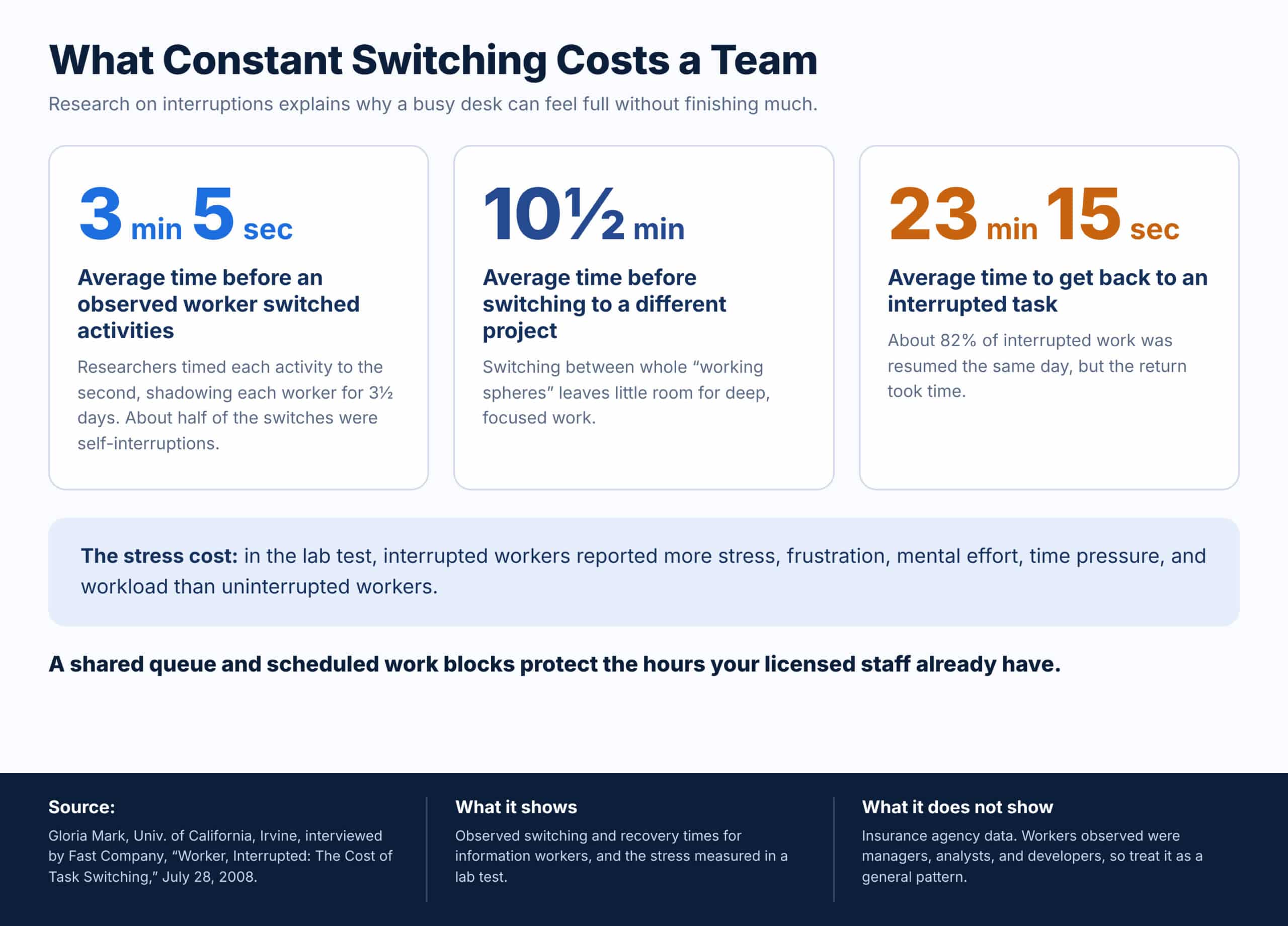
This matters because of how people work. In research by Gloria Mark of the University of California, Irvine, observed information workers switched activities every three minutes and five seconds on average, and it took an average of 23 minutes and 15 seconds to get back to an interrupted task. [6] Those workers were managers, analysts, and developers, not agency staff, but the pattern is familiar to anyone who has tried to finish a renewal while the phone rings. A single queue lets people finish one thing before opening the next.
This is where AMS management support pays off. InsurAssist supports accurate client data entry, updated policyholder records, activity note documentation, digital file organization, and audit preparation support inside your agency management system, so anyone who picks up a file can see what is still open.
Why it frees capacity: Nothing hides in one person’s inbox, so an absence slows a request down instead of stopping it.
2. Balance Workloads by Task Type, Not Headcount
Workload distribution is rarely even. One CSR becomes the person who “knows how to do certificates,” and her desk fills while others have room.
Try a weekly audit. List each person’s recurring tasks, estimate the hours each takes, and compare the total with that person’s available hours. Flag any desk running well over and any with open time, then move tasks from the first to the second. Weigh complexity, not just count: a multi-location commercial renewal takes longer than five ID card requests. The Big “I” found that small agencies were the least likely to add employees, which often leaves the same few people carrying a wide mix of tasks. [1] Written routines also strengthen day-to-day agency operations during vacations and staffing gaps.
Why it frees capacity: No one carries a hidden second job, and open time on one desk absorbs work from an overloaded one.
3. Keep Licensed Time for Licensed Work
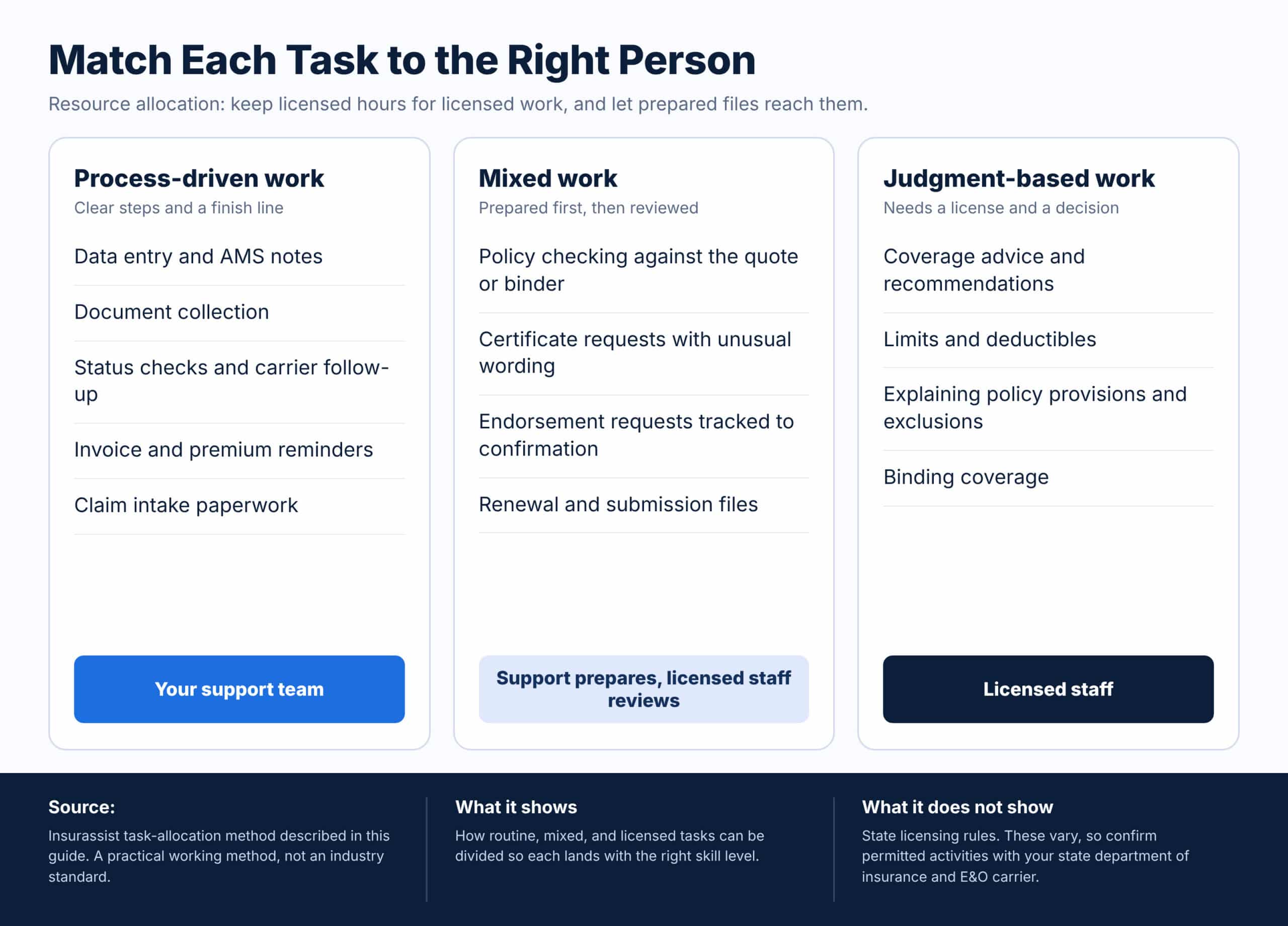
Resource allocation starts with one question: does this task need a license or a decision? If not, it should not sit on a licensed person’s desk. Process-driven work, such as data entry, document collection, status checks, and carrier follow-up, can go to trained administrative support. Judgment-based work, such as coverage advice and binding, stays with licensed staff. Mixed work is prepared by support and reviewed by a licensed person before anything goes out.
Policy servicing is a natural fit. InsurAssist supports new business policy setup, issuance follow-up with carriers, renewal processing and remarketing support, cancellation processing, and reinstatement tracking through its policy servicing work. That includes policy checking, in which a specialist compares the issued policy against the application, quote, or binder and sends any difference to the licensed team. Utica advises reviewing the binder and policy on arrival to confirm they match the terms quoted. [5]
Mid-term changes follow the same rule. Utica advises confirming that the carrier received the request, following up until it is complete, and telling the client that coverage is not in effect until the carrier confirms it. [5] A support specialist can submit endorsements, track each one to carrier confirmation, save proof in the AMS, and alert the licensed team if the carrier pushes back. For commercial accounts, commercial lines processing support covers submission preparation, ACORD form completion, loss runs, underwriting documents, and carrier follow-ups, so the producer decides what to quote and the file is already ready.
Why it frees capacity: Licensed hours go to advising, selling, and judgment calls, and files reach licensed staff already prepared.
4. Use Checklists and a Second Set of Eyes on Certificates
Certificate requests arrive at inconvenient times, such as when a contract requires proof before work starts, and the temptation is to send whatever wording was requested. Utica National calls certificates of insurance a frequent source of easily preventable E&O claims. Its advice: check whether the policy has been canceled or endorsed before issuing, never list an additional insured who has not been endorsed to the policy, and have a second person review the certificate before release. [5]
That advice is a checklist. Build one that confirms the holder, confirms the policy is in force, checks the wording against the policy, adds a second review, and documents what was issued. Requests for an additional insured, a waiver, or a limit the policy does not show go to licensed staff first. Juratovic says consistent use of a standard checklist, placed in the file with a declination or other formal documentation, is a key way to prevent the top E&O loss drivers. [4]
InsurAssist supports certificate of insurance management, including certificates of liability insurance, evidence of property insurance, additional insured endorsement tracking, certificate tracking and documentation, and compliance verification per contract requirements. Agree on a process in which the specialist flags anything the policy does not provide for licensed review instead of guessing.
Why it frees capacity: Routine certificates move quickly on a checklist, and unusual requests reach a licensed person early, which cuts rework.
5. Schedule Recurring Work Instead of Squeezing It In
Tasks that are easy to postpone when the phones are busy need a schedule most. Block recurring time for each and name an owner.
Billing. InsurAssist offers billing support that includes invoice generation support, premium follow-up reminders, payment tracking documentation, managing receivable aging reports, and supporting collection workflows. A specialist can work recurring billing tasks on a set schedule and bring unresolved items to your team, while payment plan decisions and cancellation conversations stay with licensed and management staff. Utica notes that failing to notify clients of pending cancellations, when an agency has set that precedent, can lead to a claim after a later loss. [3]
Claims intake. Utica warns that claims not forwarded to the carrier promptly can result in a denial of coverage. [3] InsurAssist supports claims intake and documentation, including first notice of loss (FNOL) intake, initial claims reporting to carriers, documentation collection, status follow-ups, and coordination between the insured, adjuster, and carrier. Coverage questions go to licensed staff, since Utica cautions against telling a client they will or will not be covered instead of directing them to submit the claim to the carrier. [3]
Client follow-up. Day-to-day client support covers insured email correspondence, renewal follow-up communication, policy document delivery, and inbound message handling, so clients keep hearing back when your CSRs are stretched.
Why it frees capacity: Aging items are touched on a schedule instead of whenever someone finds a quiet moment, and losses reach the carrier with complete information.
How Do These Ideas Apply to Agents, Small Agencies, MGAs, and Startups?
The same gaps appear in every shop, but the pressure differs by size and stage.
| Agency type | Typical pressure | How rebalancing helps |
| Solo agents and small agencies | One person quotes, services, and enters data, so one absence can stall every open item. Small agencies were least likely to add staff. [1] | Mapping the week shows which repeatable follow-up can move off that desk before a full-time hire is needed. |
| Mid-sized agencies | More staff, but more handoffs between producers, account managers, and CSRs. | A written process and one named owner per task reduce dropped items. |
| MGAs | High submission volume and a need for clean documentation and carrier follow-up. | Standard intake, checklists, and prepared submission files keep underwriting files organized. |
| Startup agencies | A fast-growing book while procedures are still being built. | Setting intake and documentation habits early is easier than rebuilding them later. |
What Is a Simple Framework for Rebalancing Daily Work?
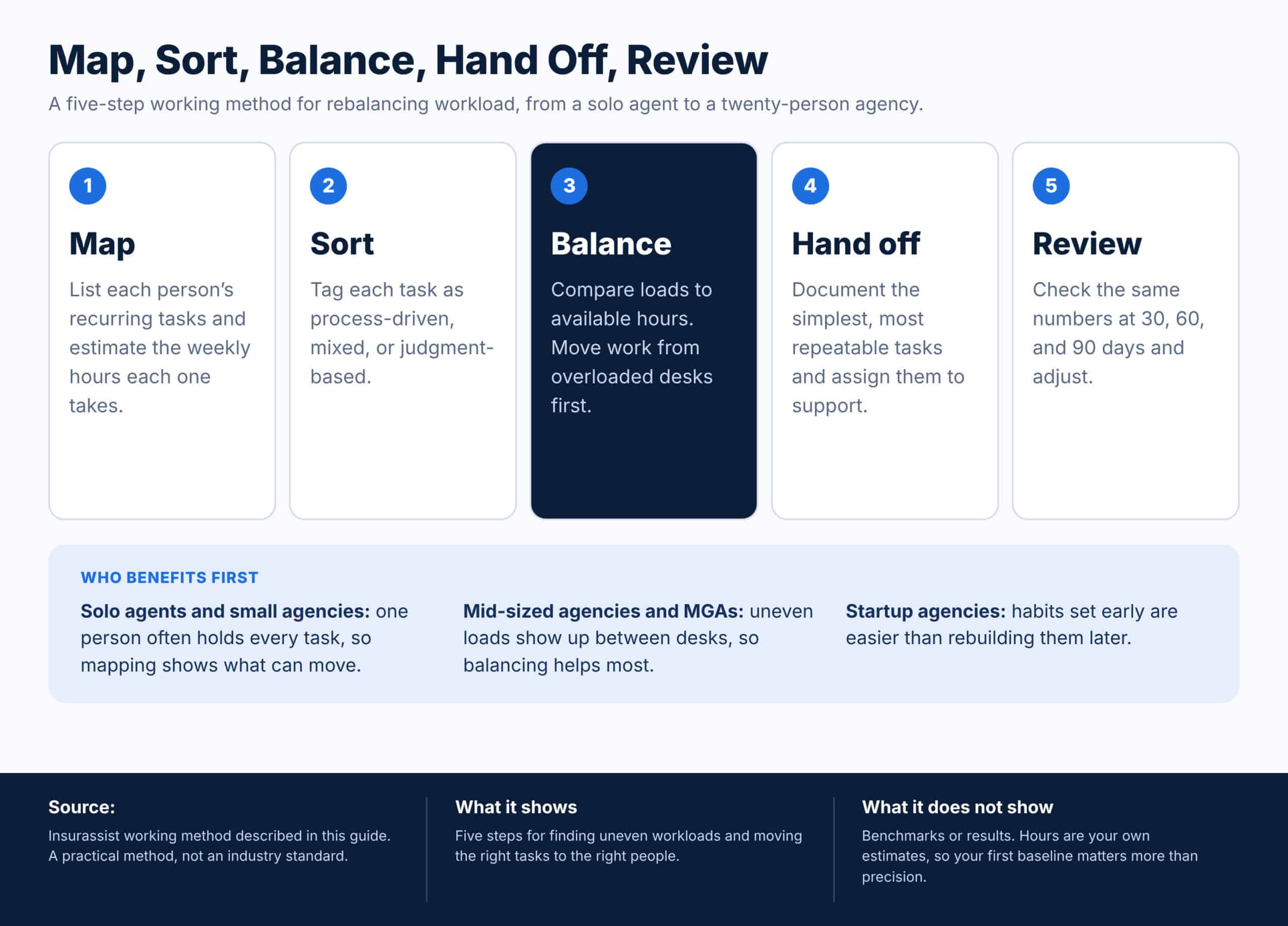
This is a practical working method, not an industry standard. It fits a solo agent and a twenty-person agency.
- List each person’s recurring tasks and estimate the weekly hours each takes.
- Tag each task as process-driven, mixed, or judgment-based.
- Compare each load with available hours and move work from overloaded desks first.
- Hand off. Document the simplest, most repeatable tasks and assign them to your support team.
- Check the same numbers at 30, 60, and 90 days and adjust.
Weekly Workload Checklist
- Every request is logged in one place with one owner and a due date.
- Open items older than your set limit are reviewed each week.
- Each person’s recurring tasks are listed with estimated weekly hours.
- One task has moved from an overloaded desk to one with room.
- Certificates are checked against the policy and reviewed by a second person.
- Endorsements are tracked to carrier confirmation, with proof saved in the AMS.
- Billing, aging receivables, and renewal lists are worked on set days.
- Notes and client declinations are recorded in the AMS.
What Stays With Licensed Staff?
Licensing requirements vary by state and by the specific activity performed. As a general operating safeguard, reserve coverage recommendations, coverage interpretations, and decisions requiring an insurance license for appropriately licensed personnel. Confirm which support activities are permitted with your state department of insurance and your E&O carrier. Examples include recommending coverage types, limits, and deductibles, explaining exclusions to the client, and binding. Where permitted, support staff can handle the work behind those decisions: gathering documents, entering data, preparing forms and certificates, and checking issued policies.
How Do Documentation and Data Security Protect the Agency?
Consistent notes protect an agency when questions arise about what was requested or completed. Utica National observes that many claims can be successfully defended with good, uniform procedures and thorough documentation. [3] Germond calls documentation “the star of the show,” so record client declinations and log communications in the AMS. [4]
Data security matters just as much when work is shared with remote team members. The National Association of Insurance Commissioners (NAIC) adopted its Insurance Data Security Model Law (#668) in October 2017. The model asks covered licensees to develop, implement, and maintain an information security program, investigate cybersecurity events, and notify the state insurance commissioner of certain events, and it exempts licensees with fewer than 10 employees from the information security program section. [7] State adoption and requirements vary, so verify the laws that apply in your jurisdiction. As a practical standard, give outside team members individual logins, role-based access, and written rules for storing and sharing client data.
How Do You Tell Whether Capacity Is Improving?
Set a baseline before you change anything, then compare the same numbers at 30, 60, and 90 days. Track how many licensed hours go to advising and selling compared with processing. That share is the clearest picture of utilization inside an agency, and it is the number a producer or account manager will notice first.
| What to measure | What to track |
| Open items | Items older than a set number of days |
| Turnaround | Endorsement and certificate turnaround time |
| Accuracy | Corrections found during policy checking |
| Receivables | Aging receivables |
| Licensed time | Share of licensed hours spent advising and selling |
| Documentation | How consistently notes and declinations are recorded |

If open items fall and corrections found at policy checking trend down, your upstream habits are improving.
How Can InsurAssist Help Agencies Put This Into Action?
At InsurAssist, we provide insurance-trained virtual assistants who support independent agencies across the United States and Canada. We integrate them into your agency management system and carrier workflows so your producers and CSRs can focus on revenue-generating work.
Our services cover policy servicing, certificates, claims intake, client support, commercial lines processing, data management, billing support, and agency growth and producer support. Our team has experience with many insurance management software systems, including Applied Systems, AMS360, Sagitta, Indio, and CSR24.
If you are weighing outside help against another full-time hire, start with clear steps: document the task, define system access, and name one internal contact. Simple, repeatable tasks such as document chasing, endorsement follow-up, and certificate requests are the easiest to hand off first.
Ready to take the next step? Explore our services, see how the process works, or book a free 30-minute strategy call.
Frequently Asked Questions
How Can an Agency Get More From Its Team Without Adding Hours?
Change how work is assigned. Log every request in one place, give each task one owner and a due date, and move process-driven work such as data entry and document collection away from licensed staff.
Which Tasks Should an Agency Hand Off First?
Start with high-volume, repeatable work such as document collection, certificate requests, and endorsement follow-up, which are easy to document and measure. Policy checking and billing support are also good early candidates.
Does Outside Support Replace Licensed Agents or CSRs?
No. Coverage advice and any activity that requires an insurance license stay with appropriately licensed staff. Confirm what applies in your state with your department of insurance and your E&O carrier.
Which Agency Management Systems Does InsurAssist Work In?
Our team has experience with many insurance management software systems, including Applied Systems, AMS360, Sagitta, Indio, and CSR24.
Who Is InsurAssist Built For?
We provide back-office support for independent insurance agencies across the United States and Canada. This guide is written for the agency side of the business, including agents, small and mid-sized agencies, MGAs, and startup agencies, not for carriers.
Research and Further Reading
[1] Big “I” and Future One, Big “I” and Future One Release 2026 Agency Universe Study, IndependentAgent.com, September 23, 2026.
[2] Big “I” and Reagan Consulting, Big “I” and Reagan Consulting Release 2025 Best Practices Study, August 12, 2025.
[3] Utica National Insurance Group, 6 Common Causes of Agents’ E&O Claims.
[4] Katie Butler, IA Magazine, What’s Driving the Rise in E&O Claims and What Can Your Agency Do to Prevent One?, May 1, 2025.
[5] Utica National Insurance Group, Certificates of Insurance and Failure to Place or Renew Coverage.
[6] Kermit Pattison, Fast Company, Worker, Interrupted: The Cost of Task Switching (interview with Gloria Mark, University of California, Irvine), July 28, 2008.
[7] National Association of Insurance Commissioners, The NAIC Insurance Data Security Model Law, legislative liaison brief.
Latest Posts

How to Improve Reconciliations With Insurance-Trained Virtual Specialists
Learn how insurance agencies can improve financial accuracy, reduce manual workload, and give their teams more capacity to focus on clients and revenue-generating work.

How a Virtual Insurance Specialist Can Streamline Certificate Requests
Discover how specialized insurance support can simplify certificate requests and reduce administrative workload.

7 Ways a Virtual Insurance Specialist Can Improve Endorsements for Insurance Agencies
Explore how specialized support can reduce repetitive service work, improve workflow efficiency, and keep client requests moving.

5 Ways Virtual Insurance Specialists Reduce Redundancy Work
See how virtual insurance specialists can take on repetitive work and give your team more time for client-focused work.

7 Ways to Unlock Greater Savings With Back Office Support
See how insurance agencies can reduce operating costs with specialized back-office support.

5 Ways Agencies Can Improve Morale Through Elite Back-Office Support
Discover how better back-office support can reduce team workload, improve employee morale, and create a stronger agency workplace.

How Agencies Can Improve Turnaround With Insurance Operations Support
Learn how insurance operations support can help agencies reduce delays, improve workflow efficiency, and keep client requests moving.

How Insurance-Trained Support Improves Executive Oversight
Learn how insurance-trained support helps agency leaders maintain visibility without getting pulled into every operational task.

How Virtual Insurance Specialists Help Agencies Reduce Cancellations
See how dedicated back-office support can help agencies stay ahead of policy issues and protect valuable client relationships.

7 Ways to Reduce High Attrition With Back-Office Insurance Support
Explore seven ways the right back-office support can reduce team strain, improve workload management, and help insurance agencies build a more sustainable operation.

7 Ways Agencies Can Reduce Rework With Insurance-Trained Specialists
Learn seven practical strategies for reducing repeated work, correcting avoidable errors, and improving agency efficiency with specialized operational support.

5 Ways Elite Back-Office Support Improves Loss Run Work
See how back-office support can help your agency handle loss run tasks more efficiently and keep accounts moving.

7 Signs of Decision Fatigue and How Virtual Insurance Specialists Help
Learn the warning signs that your agency may be reaching its service capacity and what it means for client experience.

5 Talent Challenges Solved by Virtual Insurance Specialists
Learn how insurance agencies can overcome staffing obstacles, improve operational efficiency, and support sustainable growth with specialized back office support.

Managing High Volume Renewals With Expert Back Office Support
Discover practical strategies to streamline renewal workflows, reduce administrative strain, and maintain exceptional client service during your busiest periods.