
Blog

6 Ways Insurance-Trained Virtual Specialists Support Recoverability
Nov 5, 2026
Insurance-trained virtual specialists support agency recoverability by taking repeatable, non-licensed work off your producers and CSRs: renewal processing, policy checking, endorsements, certificates, claims intake, client support, and billing. When a surge, a resignation, or a backlog hits, that trained capacity helps your team get renewals, changes, and claims back on schedule. The pressure is real. In the Big “I” 2026 Agency Universe Study, finding and screening job candidates with strong potential was the top challenge, cited by 45% of agencies, and 1 in 3 agencies said their employee count had increased in the past two years.[1] When hiring is slow, you need another way to rebuild capacity.
Key Takeaways
- Bounce-back capacity is your agency’s ability to get renewals, endorsements, certificates, and claims back on schedule after a disruption. It is a practical idea, not an industry standard.
- Hiring is the bottleneck. The Big “I” 2026 study reports that 45% of agencies named finding and screening candidates as their top challenge.
- Six agency workflows carry the most risk when the team is stretched: renewals and policy checking, endorsements, certificates, claims intake, client support, and billing with AMS records.
- A certificate does not change a policy. The ACORD 25 says so on its face, so certificates must match the policy and the contract.
- Outsourced specialists handle defined, non-licensed tasks. Coverage advice and other licensed activity stay with licensed staff.
- Agents, small and mid-sized agencies, MGAs, and startup agencies can all use the same approach: start small, set clear limits, check quality, then expand.
- Insurassist offers insurance-trained back office support across eight service areas for independent agencies in the United States and Canada, according to its website.
Introduction
It is Monday morning. Your best CSR gave notice on Friday. A hailstorm hit overnight and the phones will not stop. Three renewals are 30 days out, a contractor needs a certificate by noon, and last week’s endorsement requests are still sitting in an inbox. Nobody is careless. The agency is simply short on hands, and every open item is a chance for a missed diary, a wrong effective date, or an errors and omissions (E&O) claim.
That picture fits agencies of every size. A solo agent writing personal lines feels it. A small agency adding producers feels it. A managing general agent (MGA) with a growing book of commercial submissions feels it, and so does a startup agency building its first processes. The question is not whether disruption will come. It is how quickly your team can get back to normal when it does.
Think of that as your agency’s bounce-back capacity: how fast renewals, changes, certificates, and claims return to schedule after something knocks you off course. This guide covers six ways insurance-trained virtual specialists help and what stays with licensed staff.
What does the research say about agency capacity?
Published sources paint a consistent picture of agencies that are growing, adding technology, and still short on people.
- Agency size and hiring: the Big “I” 2026 Agency Universe Study found that agencies average 9.9 staff members across all positions, up from 8.2 in 2024. The estimated number of independent agencies fell slightly, from 39,000 in 2024 to 37,000 in 2026.[1][2] Insurance Business, covering the same study, reported that small agencies were least likely to add staff.[3]
- Channel weight: the Big “I” 2026 Market Share Report says the independent agency channel placed 62% of all U.S. property/casualty premium in 2025, up from 61.5% in 2024. Agencies wrote 87.7% of commercial lines premium and 39.5% of personal lines.[4]
- Technology load: 46% of agencies report using AI, up from 15% in 2024. The biggest technology challenge, as in previous years, was dealing with multiple carrier interfaces.[1]
- E&O exposure: the Big “I” Virtual University lists five frequent E&O claim causes: failure to procure proper coverage, misrepresentation or miscommunication, failure to renew a policy, gaps between underlying and umbrella policies, and administrative errors.[5]
None of this proves that any one agency has a problem. It does explain why a lean team can feel stretched: more clients, carrier portals, and tools all create work that someone has to finish, record, and check.
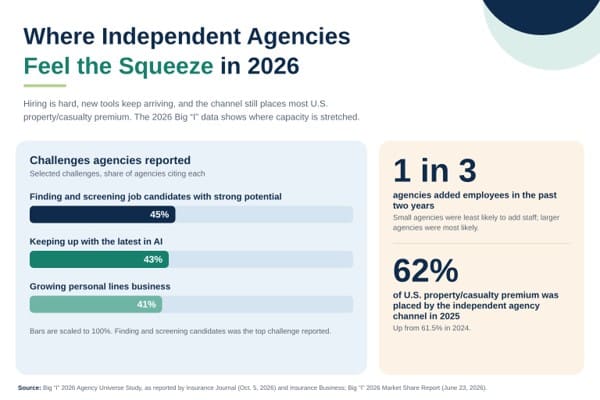
Source: Big “I” 2026 Agency Universe Study as reported by Insurance Journal and Insurance Business; Big “I” 2026 Market Share Report.
What does it mean for an agency to bounce back?
An agency that bounces back quickly shows three signs. Renewals go out on time even when someone is out. Every change, certificate, and claim report is written down in the agency management system (AMS), so a new person can pick up the file. And clients still get a prompt answer.
Insurance back office support is how many agencies get there. It means trained remote staff who handle defined administrative workflows, such as AMS entry, document indexing, policy checking, certificate tracking, claim follow-up, and billing tasks. You may also see it called a virtual insurance specialist, an insurance virtual assistant, or insurance operations support. None of those titles authorizes someone to give coverage advice. Rules on what non-licensed staff may do vary by state, so confirm them with your department of insurance or your attorney.
6 ways insurance-trained virtual specialists keep your agency steady
Each way below matches a workflow where work slips when the team is thin. Each one also names the Insurassist service that covers it, as listed on its services page.
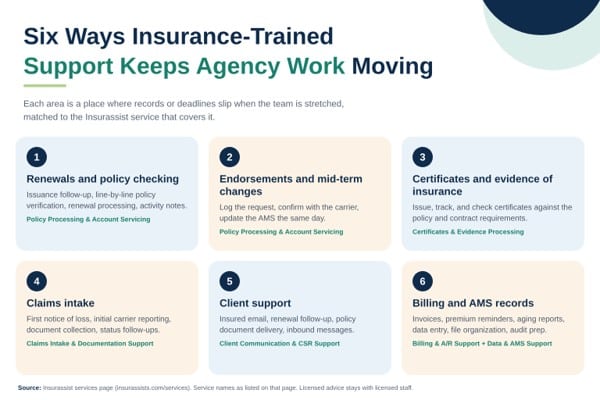
Source: Insurassist services page. Service names are shown as listed on that page.
1. Keep renewals and policy checking on schedule
Renewals are quiet until they are urgent. The Big “I” Virtual University lists failure to renew a policy among the five most frequent E&O claim causes, and it advises notifying the client about the pending renewal and confirming their preferences before you renew.[5] When a team is short, that notice is the first thing to slip.
A trained specialist can build the renewal list from your AMS, send reminders, collect updated information, prepare the submission, and follow up with carriers. The same person can run policy checking when the policy issues: compare it with the quote, the application, and the client’s request, then note any correction needed. The same article warns about administrative errors such as wrong effective dates and says, “Do not rely on the carrier to always get it right.”[5]
For commercial accounts, Insurassist lists commercial lines processing support, including submission preparation, ACORD forms, loss runs, carrier follow-ups, and proposal assembly. Its policy checking and policy servicing work covers AMS new business setup, issuance follow-up with carriers, renewals, and activity notes.
2. Process endorsements and mid-term changes the same day
A client adds a vehicle. A contractor adds an additional insured. A business opens a second location. If the request, the carrier’s confirmation, and the updated record do not all reach the file, you cannot show what changed or when. The Big “I” article describes a related problem on umbrella and excess policies: new vehicles, equipment, or locations that were never added to the schedule when required.[5]
A virtual specialist can log the request, submit it to the carrier, confirm acceptance, update the AMS, and send the client a written confirmation, all on the same day. The licensed producer still decides what coverage to recommend.
Insurassist supports endorsements and mid-term changes as part of its agency operations work, so requests are logged as they arrive. For more detail, read 7 ways a virtual insurance specialist can improve endorsements for insurance agencies.
3. Keep certificates matched to the policy
Certificates move fast. A landlord, a general contractor, or a lender wants one today. But a certificate is only a summary. The ACORD 25 states that it “is issued as a matter of information only and confers no rights upon the certificate holder,” and that it “does not affirmatively or negatively amend, extend or alter the coverage afforded by the policies below.”[6] Big “I” Insights writer Christopher Boggs reached the same conclusion in 2021: the certificate does not alter coverage.[7]
That is why accuracy matters. The holder name, the policy numbers, and any additional insured wording should match the policy and the contract. The ACORD 25 also notes that if the holder is an additional insured, the policy must have additional insured provisions or be endorsed.[6] A specialist can issue certificates from your templates, check them against contract requirements, track expirations, and flag any mismatch for a licensed team member.
Insurassist lists certificate of insurance management among its services, including certificates of liability insurance, evidence of property insurance, additional insured endorsements, tracking, and contract compliance checks. See also how a virtual insurance specialist can streamline certificate requests.
4. Take claims intake off the producer’s desk
After a loss, time matters. Many commercial general liability policies built on the ISO CG 00 01 form include a condition that says, “You must see to it that we are notified as soon as practicable of an ‘occurrence’ or an offense which may result in a claim.”[8] Forms vary, so check the policy in front of you. The point for your agency is simple: when a client calls with a loss, the first notice should be captured and sent fast, and the file should show it.
Good claims intake records the date and description of the incident, who was told, and what the carrier acknowledged. A trained specialist can take the first notice of loss (FNOL) details, report the claim to the carrier, collect documents, and follow up on status, with every contact dated in the AMS. The carrier decides coverage. Your agency keeps a clean record of what was reported and when.
Insurassist provides claims intake support, covering FNOL intake, initial carrier reporting, documentation collection, status follow-ups, and coordination among the insured, the adjuster, and the carrier.
5. Hold the client line steady with client support
Clients still want to call their agent. In the Big “I” study, 86% of agents said they prefer that customer service go through the agency by phone or other non-online methods.[1] The same study found that 57% see a significant need to train customer service staff and producers to sell on value rather than price.[2] Both facts point the same way: your people are most valuable on conversations, and they have less time for them when inboxes fill up.
A virtual specialist can manage insured email, send renewal follow-up communication, deliver policy documents, and handle inbound messages. Anything that needs coverage advice goes to a licensed teammate with the details already written up.
Insurassist offers client support through its Client Communication and CSR Support service, including insured email, renewal follow-up, policy document delivery, and live chat or inbound messages.
6. Keep billing and AMS records clean enough to rebuild from
When someone leaves or a disaster pulls the whole team onto claims, your records are the safety net. If the next person can open the file and see what happened, the agency recovers faster. If not, you spend days piecing together a history.
Payment history is part of that record. When agency bill items, carrier statements, and client payments do not match, cancellations and disputes follow. A specialist can generate invoices, send premium reminders, track payments, prepare aging reports, and reconcile items so nobody is surprised by a lapse. On the data side, the same person can enter client data, update policyholder records, write activity notes, organize digital files, and help prepare for audits. This matters because the Big “I” study again named multiple carrier interfaces as agencies’ biggest technology challenge.[1]
Insurassist lists billing and reconciliation support, including invoice generation, premium reminders, payment tracking, and receivable aging reports. Its AMS management and data management service covers data entry, record updates, activity notes, digital file organization, and audit preparation support. For a closer look, read how to improve reconciliations with insurance-trained virtual specialists.
What should stay with your licensed team?
Outside support works best when everyone knows where the line is. This table shows a common split. Your own procedures and your state’s rules decide the final answer.
| Workflow | Trained specialist can handle | Keep with licensed staff |
| Renewals | Build the renewal list, send reminders, gather information, prepare submissions | Coverage recommendations, remarketing decisions, client advice |
| Endorsements | Log requests, submit changes, confirm with the carrier, update the AMS | Deciding what coverage a change requires |
| Certificates | Issue from templates, track holders and expirations, check against contract terms | Approving unusual wording or coverage questions |
| Claims intake | Collect FNOL details, report to the carrier, gather documents, follow up | Coverage interpretation and claim strategy |
| Client support | Answer email, deliver documents, follow up on renewals | Coverage explanations and advice |
| Billing and AMS | Invoices, reminders, reconciliation, data entry, file organization | Payment arrangement and cancellation decisions the agency reserves |
Who benefits most from this approach?
Agents and solo producers. You wear every hat. A trained specialist handles the back end so a sick day or a busy renewal month does not stop service.
Small and mid-sized agencies. Insurance Business reported that small agencies were least likely to add staff.[3] Outside support lets a lean team add capacity without waiting for the right hire.
MGAs. Submissions, binding records, and program documentation grow with volume. Support for commercial submissions and ACORD forms can keep intake moving, while underwriting decisions stay with your team.
Startup agencies. You are building processes from scratch. Clear, documented workflows make it easier to bring in help as you grow.
How do you start without disrupting your team?
- Pick one workflow where work slips most often, such as renewals or certificates.
- Write down the steps, the AMS fields, and the authority limits. The Big “I” article calls a procedures manual a “living document” that should be updated when the agency outsources an activity.[5]
- Define what the specialist may do and what must go to a licensed teammate.
- Check quality. Review a small sample each month and track turnaround, open items, and corrections.
- Expand only when the first workflow runs cleanly. For ideas, read how audits help agencies get more from virtual insurance specialists.
Bounce-back readiness checklist
- Renewal list reviewed at least 60 days out, with an owner for every account
- Issued policies checked against the quote and application, with the reviewer and date noted
- Every endorsement logged with request date, effective date, and carrier confirmation
- Certificates tracked by holder, policy, and expiration date
- A written process for taking first notice of loss and reporting it to the carrier
- Procedures manual current, with a named owner for updates
If several boxes are empty, the cause may not be your people. It may be capacity.
What should you ask before you outsource?
| Question to ask | Why it matters |
| Is the team insurance-trained? | Someone who knows the difference between an endorsement and a certificate, and why a loss run matters, needs less correction. |
| Do they work inside your AMS? | Records should live in your system, not in a vendor spreadsheet. |
| Is the scope in writing? | You should know which tasks are covered and which decisions stay with licensed staff. |
| How is the work documented? | Activity notes and verification steps should look the same every time. |
| How is client data protected? | Ask about access controls and confidentiality practices before access is granted. |
How Insurassist supports your agency’s bounce-back capacity
Insurassist provides insurance-trained virtual assistants to independent agencies in the United States and Canada. According to its services page, the team integrates with the agency’s management system and carrier workflows, and has experience with Sagitta, Indio, Applied Systems, CSR24, and AMS360. Its process page says it offers continuous training and development to keep up with industry changes. The services below map to the six ways in this guide.
| Workflow | Insurassist service |
| Policy checking | AMS new business setup, issuance follow-up with carriers, policy verification, renewals, cancellations and reinstatements, activity notes. |
| Endorsements and agency operations | Support for endorsements and mid-term changes so requests and confirmations are logged as they happen. |
| Certificates | Certificates of liability insurance, evidence of property insurance, additional insured endorsements, tracking, contract compliance checks. |
| Claims intake | FNOL intake, initial carrier reporting, documentation collection, status follow-ups. |
| Client support | Insured email, renewal follow-up, policy document delivery, live chat and inbound messages. |
| Commercial lines processing | Submission preparation, ACORD forms, loss runs and underwriting documents, carrier follow-ups, proposal assembly. |
| AMS and data management | Data entry, policyholder record updates, activity notes, file organization, audit preparation, management reports. |
| Billing support | Invoice generation, premium reminders, payment tracking, receivable aging reports, collection workflows. |
For related reading, see how insurance agencies can improve resourcing with insurance-trained support, how agencies can improve turnaround with insurance operations support, and how insurance back office services can reduce overhead expenditures.
Ready to rebuild capacity in your agency? If your producers and CSRs are stretched thin, Insurassist can help with policy servicing, certificates, claims intake, client support, AMS management, and billing support. Explore the full list of insurance back office services or get started with Insurassist to talk through where your agency needs the most help.
Final Takeaway
Agencies are growing their teams, adding tools, and still struggling to find people. That combination makes a fast return to normal a real operating goal. Trained virtual specialists can take on the repeatable work behind renewals, endorsements, certificates, claims intake, client support, and billing, so your licensed team can focus on advice and relationships.
This does not mean every agency needs outsourced help, and it does not prevent every E&O claim. Test the idea on one workflow, set clear limits, check the results, and expand when the quality holds. Strong files and clear handoffs are what let a busy agency recover quickly.
FAQ
What do insurance-trained virtual specialists do for agencies?
They handle defined, non-licensed back office tasks: AMS entry, policy checking, renewal follow-up, endorsement processing, certificate tracking, claims intake, client email, and billing support. Licensed staff keep coverage advice and decisions.
Can a virtual specialist give coverage advice?
No, not for anything that requires a license. Rules on what non-licensed staff may do vary by state, so confirm them with your department of insurance or your attorney and write the limits into your procedures.
Why do certificates need to match the policy?
The ACORD 25 states that a certificate is issued as a matter of information only and does not amend, extend, or alter the coverage afforded by the policy.[6] If the certificate and the policy disagree, the policy controls, and your agency has to explain the gap.
How soon should a client report a claim?
Many commercial general liability policies based on the ISO CG 00 01 form require notice “as soon as practicable” of an occurrence or offense that may result in a claim.[8] Check the policy for the exact wording and have your team capture first notice of loss quickly.
Which agencies use this kind of support?
Insurassist says it serves independent agencies across the United States and Canada. Agents, small and mid-sized agencies, MGAs, and startup agencies that need more back office capacity can ask how the support would fit their own systems and workflows.
Research and Further Reading
[1] Insurance Journal, “Agency Universe,” reporting the Big “I” 2026 Agency Universe Study (October 5, 2026). Read the source
[2] Insurance Journal, “Independent Agencies Total About 37,000 in 2026, a Decrease From 2024” (September 24, 2026). The study had 1,376 respondents and was conducted by Zeldis Research with Future One. Read the source
[3] Insurance Business, “Independent agency revenue rose at three in four firms as AI adoption tripled, Big I study finds.” Read the source
[4] Independent Insurance Agents & Brokers of America, “Big ‘I’ Releases 2026 Market Share Report” (June 23, 2026). Read the source
[5] The Big “I” Virtual University, “Five Top Tips to Prevent the Most Frequent Errors & Omissions Claims Against Insurance Agencies” (June 13, 2025). Read the source
[6] ACORD 25 Certificate of Liability Insurance, edition 2025/12 (PDF hosted by the New York Department of Financial Services). Read the source
[7] Christopher J. Boggs, “Mistakes on Certificates Versus Clear Policy Language,” Insurance Journal, Big I Insights (July 23, 2021). Read the source
[8] Construction Executive, “The Insured’s Responsibilities in the Event of a Claim” (October 17, 2019), quoting the ISO CG 00 01 form. Read the sourc
Latest Posts

6 Ways Insurance-Trained Virtual Specialists Support Recoverability
Discover how insurance-trained professionals support renewals, endorsements, policy tasks, and daily workflows as agencies rebuild operational capacity.

5 Ways Back Office Insurance Support Helps Manage Interruption in Agency Operations
Learn how documented processes, flexible staffing, and specialized administrative support help agencies maintain service capacity during demanding periods.

Maintaining Records Accurately With Insurance Back Office Support
Learn how organized documentation, accurate policy files, and consistent recordkeeping practices help insurance agencies improve service and reduce administrative errors.

7 Ways Virtual Insurance Specialists Resolve Processing Exceptions Faster
Discover seven ways insurance agencies can address processing issues, reduce follow-up delays, and keep policy servicing moving with trained insurance support.

5 Ways We Create a Smoother Customer Journey for Insurance Agencies
Explore five ways insurance agencies can strengthen client communication, organize follow-ups, and deliver a more consistent service experience.

7 Ways Virtual Insurance Specialists Can Process Applications Faster
Discover how trained insurance support can reduce administrative bottlenecks, streamline workflows, and help agencies manage growing submission volumes.

How Insurance Back Office Services Can Reduce Overhead Expenditures
See how insurance agencies can control operating costs while maintaining the support needed to keep daily work moving.

How Audits Help Agencies Get More From Virtual Insurance Specialists
Learn how agencies can identify workflow gaps, improve team capacity, and get more value from their operational support.

How Insurance Agencies Can Improve Resourcing With Insurance-trained Support
Learn how agencies can manage workloads, strengthen teams, and access specialized support without hiring full-time staff.

How To Keep Submissions Moving With Virtual Insurance Specialists?
Learn where agency new business workflows slow down and how insurance-trained virtual support can help teams prepare, package, and follow up on accounts.

How Remote Insurance Back Office Support Makes Re-Quoting Less Time Consuming
Discover how insurance agencies can reduce repetitive quoting work, improve responsiveness, and give their teams more time for clients.

How to Improve Reconciliations With Insurance-Trained Virtual Specialists
Learn how insurance agencies can improve financial accuracy, reduce manual workload, and give their teams more capacity to focus on clients and revenue-generating work.

How a Virtual Insurance Specialist Can Streamline Certificate Requests
Discover how specialized insurance support can simplify certificate requests and reduce administrative workload.

7 Ways a Virtual Insurance Specialist Can Improve Endorsements for Insurance Agencies
Explore how specialized support can reduce repetitive service work, improve workflow efficiency, and keep client requests moving.

5 Ways Virtual Insurance Specialists Reduce Redundancy Work
See how virtual insurance specialists can take on repetitive work and give your team more time for client-focused work.