
Blog

Maintaining Records Accurately With Insurance Back Office Support
Oct 29, 2026
The best way to maintain accurate agency records is to capture every request and decision when it happens, confirm important items in writing, cross-check issued documents against the original request, and close each task in your agency management system (AMS). The case for doing this consistently is getting stronger: the Big “I” 2026 Agency Universe Study found that agencies now average 9.9 staff members across all positions, up from 8.2 in 2024, and that 46% report using AI, up from 15%. [1] More people and more tools mean more handoffs, and every handoff is a place where a record can go missing.
Key Takeaways
- Accurate records come from a repeatable process, not from effort alone. Capture, confirm, cross-check, and close every policy event.
- Big “I” research shows agencies adding staff and technology, which raises the stakes on consistent documentation and clear handoffs.
- A complete file shows what was requested, recommended, declined, issued, and changed, not just the policy itself.
- Endorsements, certificates, claims intake, and billing are where records most often slip. Same-day logging and verification close most of those gaps.
- Retention rules vary by state and start from different triggers. Confirm yours with your department of insurance, E&O carrier, or attorney.
- Outsourced back office support can handle the repeatable tasks that generate records, while coverage advice stays with licensed staff.
- InsurAssist recommends a measured approach: start with the workflows where records slip most, check quality, then expand.
Introduction
A client calls after a loss and says they asked for higher limits last spring. The producer remembers a different conversation. The carrier wants the signed application. Someone opens the file and finds a half-finished note, an unsigned form, and an endorsement that never made it into the AMS. Nobody was careless on purpose. The agency was simply busy.
That scene plays out in agencies of every size, from a solo agent writing personal lines to a managing general agent (MGA) handling a growing book of commercial submissions. The work gets done, but the proof does not always get written down, and the agency carries the risk: a missed renewal, a wrong effective date, a certificate that does not match the policy, or an errors and omissions (E&O) claim that is harder to defend.
The Big “I” 2026 Agency Universe Study, reported by Insurance Journal on October 5, 2026, puts numbers on how agencies are changing. Average staff size rose from 8.2 to 9.9, the estimated number of independent agencies slipped from 39,000 to 37,000, and AI use climbed from 15% to 46%. As agencies add people and tools, consistent documentation and clear handoffs become more important. These figures do not show that any one agency has a records problem, but they explain why informal habits that worked in a small office can strain as teams and systems grow.
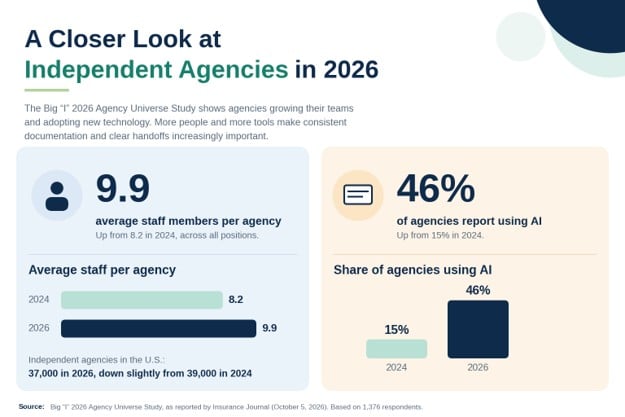
Source: Big “I” 2026 Agency Universe Study, as reported by Insurance Journal.
Insurance back office support means trained remote staff who handle defined, non-licensed administrative workflows for an agency, such as AMS entry, document indexing, policy checking, certificate tracking, claim follow-up, and billing tasks. The market uses many labels for similar help, including insurance operations support, a virtual insurance specialist, or an insurance agency virtual assistant. None of these titles authorizes the person to give coverage advice.
What the research suggests
Agency size and technology: the Big “I” study reports larger teams and much wider AI use than two years ago. [1] Both trends increase the number of people and systems that touch a client file, which supports having one consistent place and format for the record.
E&O claim causes: the Big “I” Virtual University’s June 2025 article on frequent E&O claims against agencies lists five common causes: failure to procure proper coverage, misrepresentation or miscommunication, failure to renew a policy, gaps between underlying and umbrella policies, and administrative errors. [2] Several of these are harder to prevent or resolve when documentation is incomplete, for example when a coverage conversation was never written down or a renewal diary is missing.
Documentation as defense: the same article recalls the manager’s rule that “If it’s not in the file, it didn’t happen.” It also recommends sending a declination form for any coverage the insured rejects, and notes that even if the insured never returns it, you have proof you sent it. [2] Frank Huver, writing in The Rough Notes in 2019, made a similar point: every communication between agent and insured, whether by phone, digital channel, or in person, belongs in the client’s file. [3]
Retention rules: the NAIC’s state laws on records maintenance chart shows that producer retention periods differ by state. [4] Practices should confirm the rule that applies to them rather than rely on a general number.
Better records should be treated as an operations decision, not a filing project. If no one owns the follow-through, a new tool or a new hire may simply move the gap to a different person. InsurAssist recommends defining the workflow first, then deciding who handles each step. This guide explains how organized documentation, accurate policy files, and consistent habits protect your agency and improve insurance agency operational efficiency. It covers what a complete file contains, where records break down, state retention rules, a simple framework, a practical checklist, and how insurance support services for agencies from InsurAssist can take the load off your team.
What belongs in a complete insurance agency file?
A complete client and policy file tells the story of an account without requiring anyone to ask the producer. Whatever AMS you use, the goal is one place where the record lives, in a consistent format. For most accounts, that means the following.
| Record | What to include | Why it matters |
| Signed applications | Current ACORD forms or carrier applications, signed on both new and renewal business. The Big “I” article, citing Swiss Re, advises having clients sign both. | Shows what the client represented to the carrier. |
| Declarations pages and policy forms | The issued policy, not just the binder or quote. | Reflects what the client actually holds. |
| Endorsements and mid-term changes | Each change, with the request date, effective date, and carrier confirmation. | Proves what changed and when. |
| Recommendations and declinations | What you proposed, what the client accepted, and what the client rejected, in writing. | Supports the defense if coverage is disputed. |
| Certificates and evidence of insurance | Every certificate issued, to whom, and under what contract requirement. | Keeps certificates matched to the policy. |
| Loss runs and claim notes | Reported claims, status updates, and who was contacted. | Documents claim handling from first notice. |
| Communications | Emails, call notes, and meeting summaries with names and dates. The Big “I” article asks agents to record exactly whom they spoke with, not just “the insured.” | Replaces memory with a dated record. |
| Billing and payment history | Invoices, payment arrangements, cancellation notices, and reinstatement activity. | Explains lapses and disputes. |
| Renewal activity | Remarketing efforts, comparisons, and the final decision. | Shows how the renewal decision was made. |
For MGAs and startup agencies, add binding records, submission documentation, and anything required by your program or capacity agreements.
Good files protect the agency in three ways. They reduce errors, because a clean, current file makes it easier to catch a wrong limit or mismatched certificate before the client does. They speed up service, because anyone on the team can open the file and see what happened. And they support the defense, because a dated record of what was recommended, declined, and bound helps explain events if a dispute arrives.
Where do agency records break down in daily operations?
Records rarely fail all at once. They fail at specific points in the policy lifecycle, usually in the middle of a busy week. The five workflows below deserve the closest attention.
Policy issuance and policy checking
When a carrier issues a policy, the agency should compare it against the quote, the application, and the client’s request. A wrong limit, a missing coverage, or an incorrect named insured is far cheaper to fix in week one than after a claim. Careful policy checking means someone reads the issued policy line by line, documents what was verified, and notes any corrections requested from the carrier.
Endorsements and mid-term changes
A client adds a vehicle, a contractor adds an additional insured, or a business adds a location. If the request, the carrier confirmation, and the updated record do not all land in the file, the agency cannot prove what changed or when. Handling endorsements consistently means logging the request, confirming the carrier’s acceptance, and updating the AMS the same day.
Certificates of insurance
Certificates carry real weight with clients, landlords, and contractors. Each one should match the policy, show the correct holder, and reflect any additional insured wording the contract requires. Good certificate of insurance management includes a tracking log of what was issued, to whom, and when it expires, so renewals do not leave a stale certificate in someone else’s file.
Claims intake and documentation
When a loss happens, speed and accuracy matter. Effective claims intake captures the first notice of loss, the date and description of the incident, who was told, and what the carrier acknowledged. Every follow-up with the insured, adjuster, and carrier belongs in the file with a date.
Billing and reconciliation
Payment history is part of the policy record. When agency bill items, carrier statements, and client payments do not match, cancellations and disputes follow. Consistent billing and reconciliation keeps invoices, payment reminders, and aging items documented so nobody is surprised by a lapse.
The cost of gaps: an illustrative scenario
Picture a commercial client who calls on a Friday to add a leased vehicle. The CSR agrees to submit the change Monday, but the note stays in an inbox and the request slips. Weeks later the vehicle is in an accident, and the policy does not list it.
No one acted in bad faith. A request was accepted without being logged, and nobody verified it was processed. The Big “I” article describes a similar failure among its umbrella and excess issues: new vehicles, equipment, or locations that were never added to the excess schedule when required. [2] From InsurAssist’s perspective, this is why its policy servicing list includes documentation of all activity notes alongside new business policy setup in the AMS, issuance follow-up with carriers, and cancellation processing and reinstatement tracking. The record of the work is part of the work.
How long should an agency keep records?
It depends on where you are licensed and on the type of record. The NAIC’s “State Laws on Records Maintenance” chart, part of Model #90 in its Summer 2024 Model Laws, Regulations, Guidelines and Other Resources, summarizes each state’s requirements, including producer records. [4]
| State | Reported producer retention requirement | Citation |
| Alabama | Not less than 3 years | § 27-7-33 |
| Alaska | 5 years after completion of the transaction | § 21.27.350 |
| California | At least 5 years after the expiration or cancellation of the policy | 10 CCR § 2190.2 |
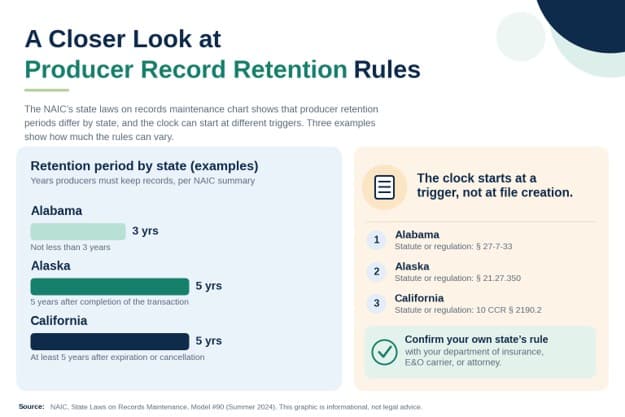
Source: NAIC, State Laws on Records Maintenance, Model #90 (Summer 2024).
The clock differs by state and by record type, and it starts at a trigger such as policy expiration, cancellation, or completion of the transaction, not necessarily the date you created the file. This article is not legal advice. Confirm the current rule with your state department of insurance, your E&O carrier’s risk management guidance, or your attorney, and write your retention schedule into your procedures manual. The Big “I” article says that manual should be a “living document,” updated whenever carriers make changes or the agency outsources an activity. [2]
What is a simple framework for keeping accurate records?
A simple working framework is Capture, Confirm, Cross-Check, Close. This is a practical model for agencies, not an industry standard. Its purpose is to give every task a clear finish line.
| Step | What to do | Evidence in the file |
| Capture | Record the request, decision, or document at the moment it happens, including who you spoke with, what was said, and what was agreed. | Dated note with names |
| Confirm | Get the other side in writing when it matters. Send the client a confirmation email of the coverage selected, send a declination form for anything rejected, and request written acknowledgment from the carrier on changes. | Confirmation email, declination form, carrier acknowledgment |
| Cross-Check | Compare the issued policy, endorsement, or certificate against the original request and the application. Log who checked it and when. | Verification note with reviewer and date |
| Close | Mark the task complete in the AMS, attach the final documents, and set the next diary or renewal date. An open item with no owner is how records decay. | Completed task, attached documents, next diary date |
Run this loop on every policy event, from new business to cancellation, and audit a small sample each month. If you cannot find a note in under a minute, the file is not finished.
Practical checklist for cleaner agency files
Use this list to review an account or train a new team member.
- Signed application on file for the current term, including renewals
- Issued policy and declarations page attached and verified
- Every endorsement logged with request date, effective date, and carrier confirmation
- Written record of coverage recommended, accepted, and declined
- Declination forms sent for any rejected coverage, with proof of sending
- Certificates issued tracked by holder, date, and expiration
- Billing, payment, and cancellation activity current and reconciled
- Retention schedule written down and reviewed each year
If more than a few of these boxes are empty, the cause may not be your people. It may be capacity, and that is where outside help can fit.
How does back office outsourcing support accurate records?
Producers and CSRs spend hours on data entry, document chasing, and follow-up that are necessary but easy to push aside. That is the gap back office outsourcing for insurance agencies is designed to fill, and it is why more owners are looking at outsourcing insurance back office work instead of adding headcount.
With remote insurance back office support, trained staff take over the repeatable tasks that generate your records: AMS entry, document indexing, policy checking, certificate tracking, claim follow-up, and billing tasks. Because the work is done the same way each time, the file looks the same no matter who opens it. That consistency is the heart of insurance agency process optimization. It also supports insurance back office compliance and insurance agency compliance support, since steady documentation makes your procedures easier to show and follow, and it strengthens insurance operations management because owners can see what was done and by whom.
When comparing insurance virtual assistant services and insurance agency outsourcing services, ask the questions below.
| Question to ask | Why it matters |
| Is the team insurance-trained? | An insurance trained virtual assistant understands the difference between an endorsement and a certificate and why a loss run matters, so the work needs less correction. |
| Do they work inside your systems? | Records should live in your AMS, not in a vendor spreadsheet. |
| Is the scope clear? | You should know which tasks are handled and which decisions stay with your licensed staff. |
| How is the work documented? | Activity notes and verification steps should be recorded the same way every time. |
| How is client data protected? | Ask about access controls and confidentiality practices before access is granted. |
Outsourced support should follow the agency’s documented procedures and authorization limits. Coverage recommendations, coverage interpretations, and other activities requiring an insurance license should remain with appropriately licensed personnel. Outsourcing also scales well: a startup agency, a small agency adding producers, or an MGA taking on a new program can add capacity as volume grows.
How InsurAssist supports better recordkeeping
InsurAssist insurance support comes from insurance trained virtual assistants supporting independent agencies across the United States and Canada. According to its services page, InsurAssist integrates them into the agency’s management system and carrier workflows, and the team has experience with insurance management software including Sagitta, Indio, Applied Systems, CSR24, and AMS360. Several services map directly to the record problems in this guide.
| Record problem | How InsurAssist support helps |
| Policy checking | Policy checking and verification, new business policy setup in the AMS, issuance follow-up with carriers, renewal processing, and documentation of activity notes help keep each policy file complete. |
| Endorsements and agency operations | Support for endorsements and mid-term changes helps agencies log requests and confirmations as they happen. |
| Certificates | Certificate tracking and documentation, plus compliance verification per contract requirements. |
| Claims intake | First notice of loss (FNOL) intake, initial claims reporting to carriers, documentation collection, and status follow-ups. |
| Client support | Managing insured email correspondence, renewal follow-up communication, and policy document delivery. |
| Commercial lines processing | Submission preparation, ACORD form completion, gathering loss runs and underwriting documentation, and proposal assembly support. |
| AMS and data management | Accurate client data entry, updating policyholder records, activity note documentation, digital file organization, and audit preparation support. |
| Billing support | Invoice generation support, premium follow-up reminders, payment tracking documentation, receivable aging reports, and support for collection workflows. |
InsurAssist describes its offering as tailored, white-glove back office support for insurance agencies. The right fit does not change how your agency works. It makes the way you already work more complete and consistent.
For related reading, see how a virtual insurance specialist can streamline certificate requests, 7 ways a virtual insurance specialist can improve endorsements for insurance agencies, and how audits help agencies get more from virtual insurance specialists. For the cost side, see how insurance back office services can reduce overhead expenditures.
Ready to put cleaner records to work in your agency? If your producers and CSRs are stretched thin, InsurAssist can help with policy servicing, certificates, claims intake, client support, AMS management, and billing support through insurance-trained virtual assistants who integrate with your AMS and carrier workflows. Explore the full list of insurance back office services or get started with InsurAssist to talk through where your agency’s records need the most help.
Final Takeaway
Maintaining records consistently is one of the most practical ways to support insurance agency operational efficiency. Published research shows agencies growing in staff and technology use, and the Big “I” Virtual University identifies documentation gaps as a factor that can make E&O claims harder to defend. It does not prove that better files prevent every claim, and it does not mean every agency needs outsourced support. The right answer has to be tested against your own workflow and capacity.
Define the workflows, assign clear ownership, run the Capture, Confirm, Cross-Check, Close loop, and audit a sample each month. The strongest recordkeeping habits are the ones your team can repeat on a busy Friday. InsurAssist recommends starting with the workflows where records slip most, measuring the result, and expanding support only when quality controls are in place.
FAQ
What should be in an insurance agency client file?
At minimum: the signed application, the issued policy and declarations, endorsements, coverage recommendations and declinations, certificates, claim notes, communications, billing history, and renewal activity. The goal is that anyone on your team can understand the account without asking the producer.
How long should an agency keep records?
It depends on your state and the type of record. The NAIC’s records maintenance chart shows different periods by state, such as not less than 3 years in Alabama and at least 5 years after policy expiration or cancellation in California. Confirm your state’s current rule and your E&O carrier’s guidance.
Why does documentation matter in an E&O claim?
The Big “I” Virtual University article says E&O allegations are difficult to defend if agency staff failed to input proper documentation in the insured’s file. It recommends keeping detailed records of client interactions, including emails, phone calls, and policy recommendations.
Why send a declination form when a client turns down coverage?
The Big “I” article recommends sending a declination form for any coverage you discuss that the insured rejects. It notes that even if the insured never returns the form, you have proof you sent it.
Can outsourced support give coverage advice?
Not for anything that requires a license. Coverage recommendations, coverage interpretations, and other licensed activities should stay with appropriately licensed personnel, and outsourced support should follow the agency’s documented procedures and authorization limits.
Which agencies use insurance-trained virtual assistants?
InsurAssist says it supports independent agencies across the United States and Canada. Agents, small and mid-sized agencies, MGAs, and startup agencies that need more capacity for back office tasks can ask how that kind of support would fit their own systems and workflows.
Research and Further Reading
[1] Insurance Journal, “Agency Universe,” reporting the Big “I” 2026 Agency Universe Study (October 5, 2026). Read the article
[2] The Big “I” Virtual University, “Five Top Tips to Prevent the Most Frequent Errors & Omissions Claims Against Insurance Agencies” (June 13, 2025). Read the article
[3] Frank Huver, The Rough Notes, “Elevated Status, Elevated Expectation.” Read the article
[4] NAIC, State Laws on Records Maintenance, Model #90, Model Laws, Regulations, Guidelines and Other Resources (Summer 2024). Read the report (PDF)
Latest Posts

6 Ways Insurance-Trained Virtual Specialists Support Recoverability
Discover how insurance-trained professionals support renewals, endorsements, policy tasks, and daily workflows as agencies rebuild operational capacity.

5 Ways Back Office Insurance Support Helps Manage Interruption in Agency Operations
Learn how documented processes, flexible staffing, and specialized administrative support help agencies maintain service capacity during demanding periods.

Maintaining Records Accurately With Insurance Back Office Support
Learn how organized documentation, accurate policy files, and consistent recordkeeping practices help insurance agencies improve service and reduce administrative errors.

7 Ways Virtual Insurance Specialists Resolve Processing Exceptions Faster
Discover seven ways insurance agencies can address processing issues, reduce follow-up delays, and keep policy servicing moving with trained insurance support.

5 Ways We Create a Smoother Customer Journey for Insurance Agencies
Explore five ways insurance agencies can strengthen client communication, organize follow-ups, and deliver a more consistent service experience.

7 Ways Virtual Insurance Specialists Can Process Applications Faster
Discover how trained insurance support can reduce administrative bottlenecks, streamline workflows, and help agencies manage growing submission volumes.

How Insurance Back Office Services Can Reduce Overhead Expenditures
See how insurance agencies can control operating costs while maintaining the support needed to keep daily work moving.

How Audits Help Agencies Get More From Virtual Insurance Specialists
Learn how agencies can identify workflow gaps, improve team capacity, and get more value from their operational support.

How Insurance Agencies Can Improve Resourcing With Insurance-trained Support
Learn how agencies can manage workloads, strengthen teams, and access specialized support without hiring full-time staff.

How To Keep Submissions Moving With Virtual Insurance Specialists?
Learn where agency new business workflows slow down and how insurance-trained virtual support can help teams prepare, package, and follow up on accounts.

How Remote Insurance Back Office Support Makes Re-Quoting Less Time Consuming
Discover how insurance agencies can reduce repetitive quoting work, improve responsiveness, and give their teams more time for clients.

How to Improve Reconciliations With Insurance-Trained Virtual Specialists
Learn how insurance agencies can improve financial accuracy, reduce manual workload, and give their teams more capacity to focus on clients and revenue-generating work.

How a Virtual Insurance Specialist Can Streamline Certificate Requests
Discover how specialized insurance support can simplify certificate requests and reduce administrative workload.

7 Ways a Virtual Insurance Specialist Can Improve Endorsements for Insurance Agencies
Explore how specialized support can reduce repetitive service work, improve workflow efficiency, and keep client requests moving.

5 Ways Virtual Insurance Specialists Reduce Redundancy Work
See how virtual insurance specialists can take on repetitive work and give your team more time for client-focused work.