Blog

5 Ways to Improve Dispatch and Task Coordination With Back Office Insurance Support
Nov 10, 2026
Back office insurance support improves dispatch and task coordination by getting every incoming request to the right person, with the right information and a due date attached. Written intake steps, named owners, and trained administrative help keep endorsements, certificates, billing, claims intake, and client follow-up moving, while licensed staff keep coverage advice and binding decisions. Five repeatable practices, covered below, make the biggest difference.
Every agency knows how a normal Tuesday can get away from you. A client emails for a certificate before a job starts. A carrier asks for a signed application. A payment does not match an invoice. A producer forwards a renewal with a note that says “can someone look at this?”
None of those requests is hard on its own. The trouble starts when they land in a shared inbox, a voicemail, a carrier portal, and an AMS task, and no one decides who handles each one or when it is due. Licensed people end up sorting mail instead of selling and advising, and small gaps turn into client complaints and errors and omissions (E&O) claims.
This guide is written for agents, small and mid-sized agencies, MGAs, and startup agencies. It explains where task coordination breaks down, how structured workflows and administrative support keep daily work on schedule, which tasks stay with licensed staff, and how to measure results. Every statistic is attributed to its original source.
Key Takeaways
- Task coordination fails when requests arrive in many places and no one owns the next step or the due date.
- Unfinished routine items, such as an unconfirmed endorsement, an inaccurate certificate, or a late claim report, are where agency E&O exposure often begins.
- Five practices keep daily work organized: one front door for requests, clear owners and due dates, checklists, scheduled follow-up, and early commercial prep.
- Coverage advice, binding decisions, and any activity that requires a license stay with appropriately licensed staff.
- Measure open items, turnaround, corrections, aging receivables, and documentation at 30, 60, and 90 days.
What Does Task Coordination Look Like Inside an Insurance Agency?
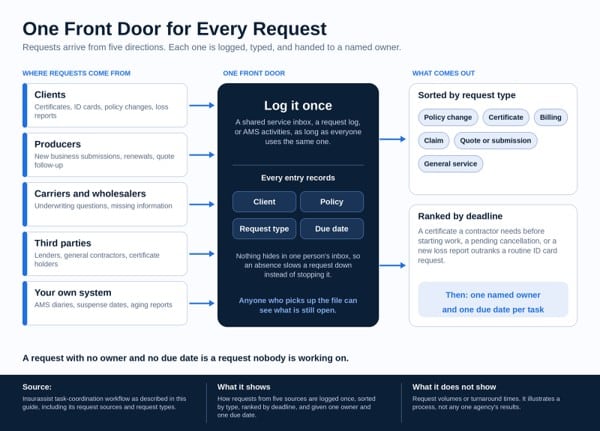
Task coordination is the day-to-day job of getting each request to the person who can finish it, then confirming it got done. Requests come from many directions:
- Calls, emails, and texts asking for ID cards, certificates, policy changes, billing answers, or help with a loss.
- New business submissions, renewal marketing, and quote follow-up.
- Carriers and wholesalers. Underwriting questions, missing information, and endorsements to confirm.
- Third parties. Lenders, general contractors, and other certificate holders.
- Your own system. AMS diaries, suspense dates, renewal lists, and aging reports.
Each one is a small task with an owner, a deadline, and a finish line. With a clear routine for sorting, assigning, tracking, and closing them, work moves. Without one, the loudest request gets handled first, and the quiet ones, often the protective follow-ups, wait.
Why Do Task Coordination Gaps Cost Agencies More Than They Look?
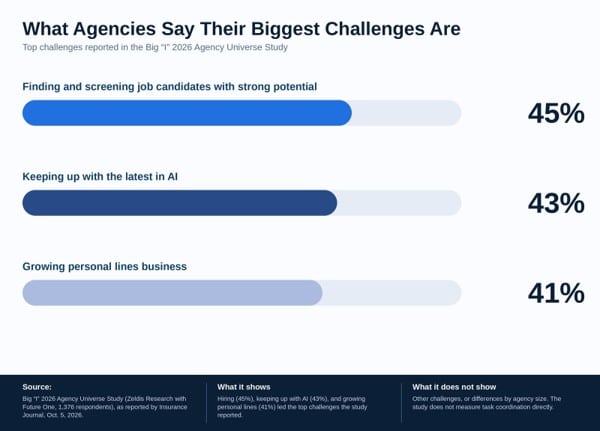
The Big “I” 2026 Agency Universe Study, conducted by Zeldis Research in cooperation with Future One and based on 1,376 respondents, estimates that roughly 37,000 independent agencies operate in the United States, down from 39,000 in 2024. [1] The study’s top challenges for agencies were finding and screening job candidates with strong potential (45%), keeping up with the latest in AI (43%), and growing personal lines business (41%). [2] The same research found that average agency staff size grew from 8.2 employees in 2024 to 9.9 in 2026, and it identified dealing with multiple carrier interfaces as the biggest technology challenge. [1][3] More people and more carrier portals mean more handoffs between producers, account managers, and service reps, and each handoff is a place where a document or a follow-up can be dropped.
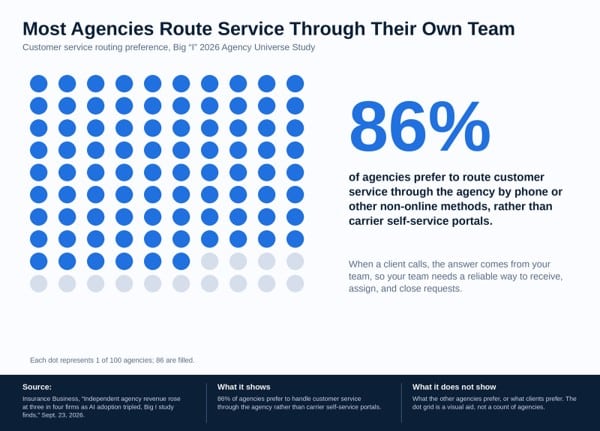
Service expectations add pressure. According to the study, 86% of agencies prefer to route customer service through the agency by phone or other non-online methods rather than carrier self-service portals. [3] When a client calls, the answer comes from your team, so your team needs a reliable way to receive, assign, and close requests.
How Do Unassigned Tasks Become E&O Problems?
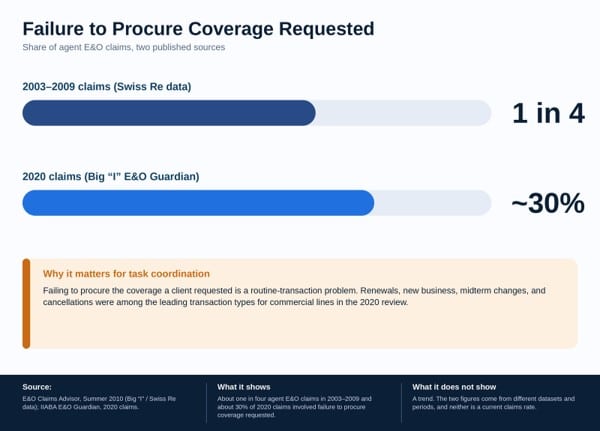
Unfinished service work can become an E&O problem. In an analysis of Swiss Re agent E&O claims data from 2003 through 2009, published in the Big “I” Professional Liability Program’s E&O Claims Advisor in 2010, one in four claims came from failing to procure coverage requested. The same article reported that producers were involved in 38% of E&O claims and CSRs in 22%. [4] That is historical data, not a current claims rate. Big “I” commentary on 2020 claims reported that failure to procure coverage accounted for about 30% of all claims, and that renewals, new business, midterm changes, and cancellations were among the leading transaction types for commercial lines. [5]
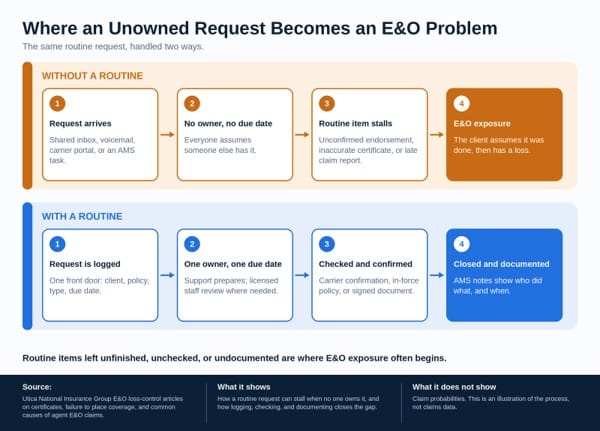
Utica National’s agent E&O risk management series describes certificates of insurance as a frequent source of easily preventable E&O claims. [6] Its list of six common causes of agent E&O claims also includes cancellation and replacement failures, where clients are not told about pending cancellations, and late or incomplete claim reporting, where claims are not forwarded to the carrier promptly. [7]
These are routine transactions that were not finished, checked, or documented, and they slip when nobody owns the next step.
5 Ways Back Office Support Improves Task Coordination
The five practices below follow the services Insurassist provides to independent agencies. None of them replaces licensed judgment. Each one covers the preparation, follow-up, and documentation work around it.
1. Give Every Request One Front Door
Start by deciding where work enters the agency. A shared service inbox, a request log, or AMS activities all work, as long as everyone uses the same one. Log each request with the client, policy, request type, and due date.
A short list of request types makes sorting fast: policy change, certificate, billing, claim, quote or submission, and general service. Then rank by deadline. A certificate needed before a contractor can start work, a pending cancellation, and a new loss report all outrank a routine ID card request.
This is where AMS management support pays off. Insurassist supports accurate client data entry, updated policyholder records, activity note documentation, digital file organization, and audit preparation support inside your agency management system. When requests are logged in the AMS, anyone who picks up the file can see what is still open.
Why it improves task coordination: Nothing hides in one person’s inbox, so an absence slows a request down instead of stopping it.
2. Assign Owners and Due Dates Based on Task Type
Once a request is logged, the next question is who does it. Split work by the kind of judgment it needs. Process-driven work, such as data entry, document collection, status checks, and carrier follow-up, goes to administrative support. Judgment-based work, such as coverage advice and binding decisions, goes to licensed staff. Mixed work is prepared by support and reviewed by a licensed person before anything goes out.
Every task gets one named owner and one due date. A task with two owners usually has none.
Policy servicing is a natural fit for this model. Insurassist supports new business policy setup, issuance follow-up with carriers, renewal processing and remarketing support, cancellation processing, and reinstatement tracking through its policy servicing work. That includes policy checking and verification, a simple safeguard in which a specialist compares the issued policy against the application, quote, or binder. The check covers named insured, mailing address, effective dates, limits, deductibles, additional insureds, mortgagees or loss payees, and listed forms. Any difference goes to the licensed team. A wrong limit or missing loss payee is far easier to fix right after issuance than after a loss.
Mid-term changes need the same discipline. A client who asks to add a vehicle assumes it is done once they ask. Utica National’s guidance on failure to place coverage advises agencies to confirm that the carrier received the coverage request, follow up as needed, and make clear to the client that coverage is not in effect until the carrier confirms it. [6] A support specialist can submit endorsements, track each one to carrier confirmation, save proof in the AMS, and alert the licensed team if the carrier pushes back. That keeps requests from aging in an inbox and strengthens day-to-day agency operations during staffing gaps.
Why it improves task coordination: Each task has one owner, one due date, and a clear finish line, so nothing waits for someone to notice it.
3. Use Checklists for Certificates and Policy Checking
Certificate requests rarely arrive at a convenient time. They show up when a client is bidding on a job or when a contract requires proof before work can start, and the temptation is to send whatever wording was requested. Utica National identifies certificates of insurance as a frequent source of easily preventable E&O claims. [6] In one example from the same article, an agent issued a certificate showing coverage after the carrier had non-renewed the policy, and the client’s accident led to a $3,500 settlement. Utica’s takeaway: do not issue a certificate unless there is an in-force policy. [6]
The ACORD 25 Certificate of Liability Insurance states on its face that it is issued as a matter of information only and confers no rights upon the certificate holder, and that it does not affirmatively or negatively amend, extend, or alter the coverage afforded by the policies. [8] In other words, the certificate must reflect what the policy actually provides, not what the contract hopes it provides.
Routine requests follow one checklist: confirm the holder, confirm the policy is in force, check the wording against the policy, and document what was issued. Requests for an additional insured, a waiver, or a limit the policy does not show go to licensed staff first.
Insurassist supports certificate of insurance management, including certificates of liability insurance, evidence of property insurance, additional insured endorsement tracking, certificate tracking and documentation, and compliance verification against contract requirements. When a contract asks for something the policy does not provide, the specialist flags it rather than guessing.
Why it improves task coordination: Routine certificates move fast on a checklist, and unusual requests reach a licensed person early.
4. Schedule Billing, Claims Intake, and Client Follow-Up
Some tasks are easy to postpone when the phones are busy, and those are the ones that need a schedule most.
Billing. A payment posts to the wrong invoice, a premium reminder does not go out, or an aging receivable sits for weeks. Insurassist offers billing support that includes invoice generation support, premium follow-up reminders, payment tracking, managing receivable aging reports, and supporting collection workflows. A specialist can handle recurring billing tasks on a set schedule, document payment activity in the AMS, and bring unresolved items to your team. Decisions about payment plans, coverage consequences, and client conversations about cancellation stay with your licensed and management staff.
Utica National’s risk series notes that failing to notify clients of pending cancellations can result in a claim when a client has a loss after the cancellation. [7] Follow your written procedures and the applicable carrier and state requirements, track deadlines, and document every communication.
Claims intake. When a client reports a loss, speed and completeness matter. Utica National lists late or incomplete claim reporting among the common causes of agent E&O claims. [7] Insurassist supports claims intake workflows, including first notice of loss (FNOL) intake, initial claims reporting to carriers, documentation collection, status follow-ups, and coordination support between the insured, the adjuster, and the carrier. Coverage questions and claim advice go to appropriately licensed staff. The support team gathers the facts, files the notice, and keeps the file current.
Client follow-up. Day-to-day client support covers insured email correspondence, renewal follow-up communication, policy document delivery, and inbound message handling, so clients keep hearing back when your CSRs are stretched.
Why it improves task coordination: Aging items are touched on a schedule instead of whenever someone finds a quiet moment, and losses reach the carrier with complete information.
5. Prepare Commercial Lines and Producer Work Before Deadlines Hit
Submissions need ACORD applications, loss runs, and supporting documents, and carriers and wholesalers follow up with questions. When producers are out selling, that work stalls first.
For commercial accounts, commercial lines processing support covers submission preparation, ACORD form completion, gathering loss runs and underwriting documentation, and carrier follow-ups. The producer still decides what to recommend and what to quote. The support team has the file ready, so the decision does not wait on paperwork.
A simple rhythm helps: pull the renewal list well ahead of effective dates, assign submission prep to a named person, and set a due date for each missing item. Renewals matter because the Big “I” review of 2020 claims named them a leading transaction type for commercial lines claims. [5]
Why it improves task coordination: Producers receive complete files, and submissions leave the agency on time.
Why Does This Matter for Agents, Small Agencies, MGAs, and Startups?
The same gaps appear in every shop, but the pressure differs by size and stage.
| Agency type | Typical pressure | How back office support helps |
| Solo agents and small agencies | One person quotes, services, and enters data, so a single busy week or one absence can stall every open item. | Taking repeatable follow-up off that desk keeps service moving without an immediate full-time hire. |
| Mid-sized agencies | More staff, but more handoffs between producers, account managers, and CSRs. | A written process and a named owner for each step reduce dropped tasks. |
| MGAs | High submission volume and the need for clean documentation and carrier follow-up. | Dedicated help with submission preparation, documentation, and follow-up keeps underwriting files organized. |
| Startup agencies | A fast-growing book while procedures are still being built. | Building intake and documentation habits early is easier than rebuilding them later. |
What Is a Simple Framework for Coordinating Daily Tasks?
This is a practical working method, not an industry standard. It works for a solo agent and a twenty-person agency.
- Log every request in one place with the client, policy, request type, and due date.
- Tag each item by type and urgency, with deadlines driving the order.
- Give each task one owner. Process-driven work goes to your support team and judgment-based work goes to licensed staff, with the file already prepared.
- Verify the result against the policy, carrier confirmation, or signed document.
- Record what happened, who did it, and when in the AMS activity notes.
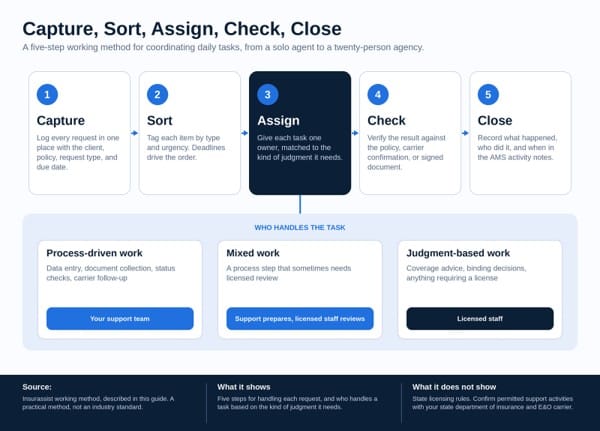
| Task type | Examples | Who handles it |
| Licensed or judgment-based | Coverage advice, binding decisions, anything requiring a license | Licensed staff |
| Process-driven | Data entry, document collection, status checks | Your support team |
| Mixed | A process step that sometimes needs licensed review | Support team prepares the item; licensed staff reviews it |
Then sort each task by who should handle it:
What Stays with Licensed Staff?
Licensing requirements vary by state and by the specific activity performed. As a general operating safeguard, reserve coverage recommendations, coverage interpretations, and decisions requiring an insurance license for appropriately licensed personnel. Confirm permitted support activities with your state department of insurance and your E&O carrier. Examples include recommending coverage types, limits, and deductibles, explaining policy provisions and exclusions to the client, and binding. Where permitted, support staff can handle the work behind those decisions: gathering documents, entering data, preparing forms and certificates, and checking issued policies.
How Do Documentation and Data Security Protect the Agency?
Consistent notes help protect an agency when questions arise about what was requested, communicated, or completed. Utica National observes that many claims can be successfully defended with good, uniform procedures and thorough documentation. [7] Record client declinations, log communications in the AMS, and follow written procedures.
Data security matters just as much when work is shared with remote team members. The National Association of Insurance Commissioners (NAIC) adopted its Insurance Data Security Model Law (#668) in 2017. The model calls for covered licensees to develop, implement, and maintain a risk-based information security program, investigate cybersecurity events, and notify the state insurance commissioner of certain events. It also exempts licensees with fewer than 10 employees from the information security program requirements. [9] State adoption and requirements vary, so agencies should verify the laws that apply in their own jurisdictions. As a practical standard, remote team members should work under individual logins, role-based access, and documented rules for storing and sharing client data.
How Do You Tell Whether Task Coordination Is Improving?
Set a baseline before you change anything, then compare the same numbers at 30, 60, and 90 days.
| What to measure | What to track |
| Open items | Items older than a set number of days |
| Turnaround | Endorsement and certificate turnaround time |
| Accuracy | Corrections found during policy checking |
| Receivables | Aging receivables |
| Documentation | How consistently notes and declinations are recorded |
If open items fall and corrections found at policy checking trend down, your upstream habits are improving.
How Can Insurassist Help Agencies Put This into Action?
At Insurassist, we provide virtual assistants who support independent insurance agencies across the United States and Canada. Our team comprises experienced professionals with deep knowledge in insurance operations, and our virtual assistants work alongside your team so your producers and CSRs can focus on revenue-generating work.
Our services cover policy servicing, certificates, claims intake, client support, commercial lines processing, data management, billing support, and agency growth and producer support. Our team has experience with many insurance management software systems, including Applied Systems, AMS360, Sagitta, Indio, and CSR24.
If you are weighing outside help against another full-time hire, start with clear steps: document the task, define system access, and name one internal contact. The simplest, most repeatable tasks, such as document chasing, endorsement follow-up, and certificate requests, are the easiest to hand off first.
Ready to take the next step? Explore our services, see how the process works, or book a free 30-minute strategy call.
Frequently Asked Questions
What does back office insurance support cover for an agency?
Back office insurance support covers the process-driven work behind your policies and clients, including policy checking, endorsements, certificates, claims intake, client communication, ACORD form completion, AMS data entry, and billing support.
Does outside support replace licensed agents or CSRs?
No. Coverage advice and any activity that requires an insurance license stay with appropriately licensed staff. Confirm what applies in your state with your department of insurance.
Which tasks should an agency hand off first?
Start with high-volume, repeatable work such as document collection, certificate requests, and endorsement follow-up. They have clear steps and finish lines, so they are easiest to document and measure.
Which agency management systems does Insurassist work in?
Our team has experience with many insurance management software systems, including Applied Systems, AMS360, Sagitta, Indio, and CSR24.
Who is Insurassist built for?
We provide back office support for independent insurance agencies across the United States and Canada. This guide is written for the agency side of the business, including agents, small and mid-sized agencies, MGAs, and startup agencies, not for carriers.
Research and Further Readings
[1] Insurance Journal, “Independent Agencies Total About 37,000 in 2026, a Decrease From 2024,” September 24, 2026.
[2] Insurance Journal, “Agency Universe,” Insurance Journal Magazine, October 5, 2026.
[3] Insurance Business, “Independent agency revenue rose at three in four firms as AI adoption tripled, Big I study finds,” September 23, 2026.
[4] Big “I” Professional Liability Program / Swiss Re, “New E&O Claims Data Reveal Same Patterns,” E&O Claims Advisor, Summer 2010.
[5] Independent Insurance Agents & Brokers of America, “Good Riddance: A Look Back At the Causes of Errors & Omissions Claims in 2020,” E&O Guardian.
[6] Utica National Insurance Group, “Certificates of Insurance and Failure to Place or Renew Coverage.”
[7] Utica National Insurance Group, “6 Common Causes of Agents’ E&O Claims.”
[8] ACORD, “ACORD 25 Certificate of Liability Insurance” (form copy posted by the New York State Department of Financial Services).
[9] National Association of Insurance Commissioners, “The NAIC Insurance Data Security Model Law” government affairs brief
Latest Posts

5 Things to Know Before Pursuing Carrier Appointments
Explore the key considerations behind adding carrier relationships, from eligibility requirements to operational capacity and growth opportunities.

How to Improve Utilization Without Increasing Team Workloads
Discover how better workload distribution and resource allocation can improve productivity and make better use of available staff capacity.

5 Retrieval Process Mistakes That Slow Down Insurance Agency Operations
Identify common documentation and record management gaps that affect agency productivity, and discover ways to improve information accessibility and administrative efficiency.

5 Ways to Improve Dispatch and Task Coordination With Back Office Insurance Support
Discover how structured workflows, clear task assignments, and trained insurance support professionals help agencies coordinate daily requests and manage administrative workloads more efficiently.

6 Ways Insurance-Trained Virtual Specialists Support Recoverability
Discover how insurance-trained professionals support renewals, endorsements, policy tasks, and daily workflows as agencies rebuild operational capacity.

5 Ways Back Office Insurance Support Helps Manage Interruption in Agency Operations
Learn how documented processes, flexible staffing, and specialized administrative support help agencies maintain service capacity during demanding periods.

Maintaining Records Accurately With Insurance Back Office Support
Learn how organized documentation, accurate policy files, and consistent recordkeeping practices help insurance agencies improve service and reduce administrative errors.

7 Ways Virtual Insurance Specialists Resolve Processing Exceptions Faster
Discover seven ways insurance agencies can address processing issues, reduce follow-up delays, and keep policy servicing moving with trained insurance support.

5 Ways We Create a Smoother Customer Journey for Insurance Agencies
Explore five ways insurance agencies can strengthen client communication, organize follow-ups, and deliver a more consistent service experience.

7 Ways Virtual Insurance Specialists Can Process Applications Faster
Discover how trained insurance support can reduce administrative bottlenecks, streamline workflows, and help agencies manage growing submission volumes.

How Insurance Back Office Services Can Reduce Overhead Expenditures
See how insurance agencies can control operating costs while maintaining the support needed to keep daily work moving.

How Audits Help Agencies Get More From Virtual Insurance Specialists
Learn how agencies can identify workflow gaps, improve team capacity, and get more value from their operational support.

How Insurance Agencies Can Improve Resourcing With Insurance-trained Support
Learn how agencies can manage workloads, strengthen teams, and access specialized support without hiring full-time staff.

How To Keep Submissions Moving With Virtual Insurance Specialists?
Learn where agency new business workflows slow down and how insurance-trained virtual support can help teams prepare, package, and follow up on accounts.

How Remote Insurance Back Office Support Makes Re-Quoting Less Time Consuming
Discover how insurance agencies can reduce repetitive quoting work, improve responsiveness, and give their teams more time for clients.